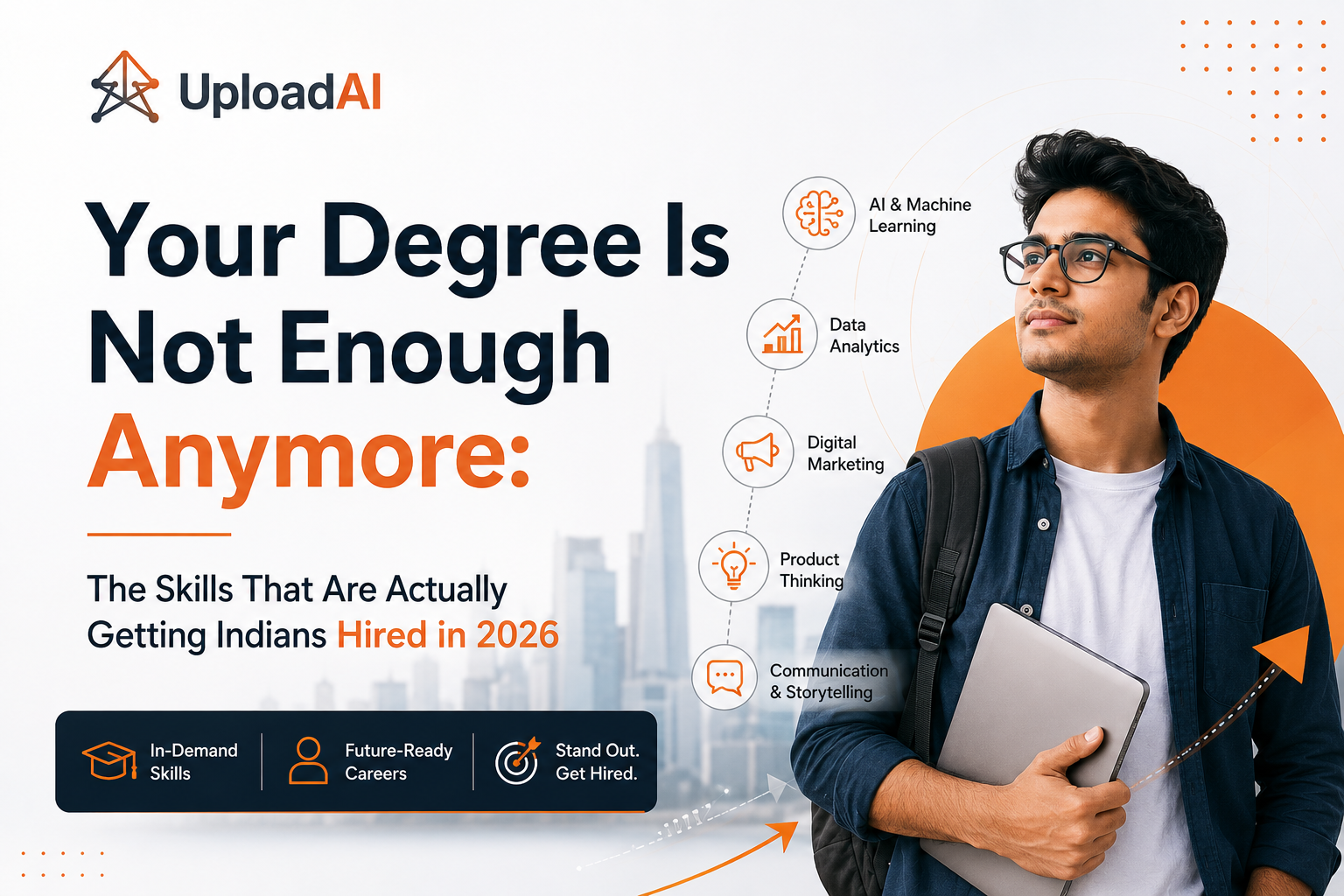
Your Degree Is Not Enough Anymore: The Skills That Are Actually Getting Indians Hired in 2026
A college degree alone is no longer enough to secure high-paying jobs in India. In 2026, employers are prioritising practical skills like AI, data analytics, cybersecurity, full-stack development, UX, and communication over academic qualifications alone. Students who combine degrees with real-world projects, certifications, and hands-on experience are landing better opportunities and significantly higher salaries.
May 18, 2026 · 12 min read
Somewhere in India right now, a family is having a very familiar conversation. It goes something like this.
The student wants to learn something new — a coding course, a design certification, a content creation skill they picked up watching YouTube at midnight. The parent wants to know how this fits around the engineering degree. The student says the degree might not matter as much as they think anymore. The parent says a degree will always matter. The student opens their laptop to show them something. The parent is not sure they want to see it.
This conversation is happening in flats in Bengaluru and houses in Lucknow and hostels in Pune, and across thousands of WhatsApp threads where older siblings send links to younger ones and say: things have changed, pay attention.
They are right. Things have changed. The question is not whether — the data has already settled that. The question is: changed enough to matter for your career? Changed enough to change how you spend your next two years?
The honest answer, backed by the most comprehensive look at Indian hiring in 2026, is yes.
What the India Skills Report 2026 Actually Says
<!-- AD PLACEMENT: In-content ad after intro -->
Every year, a report compiled by ETS in partnership with the Confederation of Indian Industry, AICTE, and over one thousand employers across seven key sectors takes a detailed picture of the gap between Indian education and Indian employment. The 2026 edition paints a picture that every student and parent in this country should understand.
India's overall employability rate has risen to 56.35 percent — up from 54.81 percent the previous year. That is progress, and it is worth acknowledging. But read that number from the other direction and it means that nearly half of all graduates entering the Indian workforce in 2026 are considered not ready for the jobs available.
The gap between different types of graduates is stark. Computer science graduates have an employability rate of approximately 80 percent — meaning four out of five are considered job-ready. IT engineering graduates follow closely at 78 percent. Meanwhile, graduates from disciplines without a technology or practical skills component lag significantly behind, often in the range of 40 to 50 percent.
More striking than the employability numbers is what employers are actually saying about what they want. Eighty percent of Indian employers now prioritise practical expertise over academic qualifications alone. Not instead of — over. A degree is increasingly functioning as an entry-level filter rather than a differentiator. It tells employers that you showed up and completed something. What they actually want to know — what determines whether you land the ₹6 LPA offer or the ₹18 LPA offer — is what you can do on day one.
And the salary gap between those two groups is not shrinking. It is widening.
The Two-Tier Hiring Reality
Here is what is actually happening inside India's largest employers, and what almost nobody tells students until it is too late.
India's major IT companies — the Infosyses, the TCSes, the HCLTechs — have moved toward what insiders call tiered hiring structures. They are no longer offering a single category of offer to campus recruits. They are offering two, sometimes three different tracks.
The standard track takes graduates who have completed a conventional degree with reasonable marks. These candidates are offered packages in the ₹3.5 to ₹6 LPA range. They enter extended training programmes. Many will spend their first year learning what they were not taught in college.
The specialist or innovator track is offered to graduates — from any college, not just IITs and NITs — who demonstrate specific, demonstrable technical skills. These candidates are offered starting packages of ₹15 to ₹25 LPA. They are placed into live projects within weeks of joining. Their trajectory is measurably different from day one.
The difference between these two tracks is not your college. It is not entirely your CGPA. It is whether you can demonstrate, through projects, certifications, and practical work, that you have built skills the company actually needs — before you walked through the door.
This is a structural shift, not a temporary condition. Ninety percent of employees in India are already using generative AI tools in their work, according to recent workforce surveys. Graduates arriving without any fluency in these tools are starting at an immediate disadvantage regardless of their degree classification.
The Skills That Are Actually Creating the Salary Gap
<!-- AD PLACEMENT: Mid-article ad unit -->
So what, specifically, are we talking about? Here is where to focus, with context on why each of these areas is genuinely worth your time.
Agentic AI and Large Language Model Literacy
This is the fastest-moving area of demand. Companies are not just looking for people who can use ChatGPT — they are looking for people who understand how to build workflows around AI tools, how to integrate AI outputs into real business processes, and how to evaluate when AI is helping and when it is confidently producing nonsense. Frameworks like LangChain and tools for building automated pipelines are being searched for in job descriptions at every level from fresher to senior. You do not need to be a research scientist. You need to be someone who has actually built something.
Data Analytics and Visualisation
The ability to take a dataset, understand what it is telling you, and present that understanding clearly to people who did not study data science — this skill is in demand across every sector, not just technology. Finance companies, healthcare organisations, logistics firms, media companies: they all have data and most of them lack people who can make sense of it. Tools like Python for analysis, SQL for querying databases, and Tableau or Power BI for visualisation are learnable in a matter of months with consistent effort, and they have transformed salary trajectories for graduates from disciplines ranging from B.Com to B.Sc Biology.
Cybersecurity Fundamentals
India's cyber incident rate doubled between 2024 and 2025. The demand for people who understand how to protect systems, manage identity and access, and think about digital security as a business problem — not just a technical one — has outpaced supply at almost every level. Entry-level roles in cybersecurity are offering packages of ₹12 to ₹18 LPA, and the pipeline of qualified candidates is not keeping up. This is an area where a motivated learner with six months of focused study and a recognised certification can genuinely compete with people who have spent three years in a formal programme.
Full-Stack Development with DevOps Understanding
Writing code is no longer the whole job. The expectation in 2026 is that a developer understands not just how to build something, but how to deploy it, scale it, and maintain it. The combination of frontend and backend development skills alongside familiarity with containerisation tools like Docker and deployment platforms like Kubernetes has created a profile — sometimes called the Platform Engineer — that companies are actively struggling to hire. The good news is that the resources to learn this stack have never been better or more accessible.
UX and Product Thinking
This one surprises people. Design is no longer primarily an aesthetic discipline. In the product-led companies that are defining India's startup economy — the Swiggys, the Razorpays, the Zerodhas — the people who understand how users think, what makes a product intuitive, and how to measure whether a design change is actually working are among the most valued people in the building. Figma is learnable. Design thinking is learnable. The combination of these skills with any subject-matter expertise — whether that is finance, healthcare, or education — creates a profile that genuinely commands premium compensation.
Communication, Critical Thinking, and Presentation
These are not soft skills in the dismissive sense that phrase is often used. They are the skills that determine whether technical capability gets recognised, promoted, and trusted with more responsibility — or stays invisible. The World Economic Forum consistently places critical thinking and communication among the top skills employers globally say they cannot find. In the Indian context specifically, the ability to articulate ideas clearly in English and in structured writing or presentations is a genuine differentiator at every level from fresher to senior management.
The Microcredential Revolution: What the Degree Is Competing Against
Part of what has changed the landscape is not just employer preferences. It is what a motivated learner can now do in six to twelve months outside of a formal degree programme.
The rise of microcredentials — structured, assessable certifications in specific skill areas, offered by platforms like Coursera, NPTEL, Google, AWS, and Microsoft — has created a parallel learning economy that is increasingly recognised by employers as legitimate evidence of capability.
India's Budget 2026 explicitly addressed this shift, placing skill development, job-linked education, and learn-and-earn models at the centre of employment strategy. The government's National Apprenticeship Promotion Scheme and the expansion of vocational training programmes represent a formal acknowledgment that the traditional four-year degree, as the primary pathway to employment, is no longer sufficient on its own.
This does not mean degrees are worthless. A degree provides structured thinking, a professional network, and the credentialing that many opportunities still require as a baseline. What it means is that a degree alone — completed without building demonstrable skills alongside it — is delivering a diminishing return on the time and money invested.
The graduates who are winning in the 2026 market are not those who chose between a degree and skills. They are those who understood, early enough, that the degree was the floor and the skills were the ceiling.
A Practical Roadmap for Students in India Right Now
<!-- AD PLACEMENT: Ad unit before final sections -->
If you are a student reading this — whether you are in your first year of college or preparing to graduate — here is a concrete framework for thinking about the next twelve months.
Step one: Audit your current position honestly. Open the India Skills Report 2026 findings for your field and look at the employability numbers for your category of graduate. If the number is below 60 percent, that is information you need to act on, not ignore.
Step two: Pick one technical skill and go deep. Not three. Not five. One. The mistake most students make is dabbling broadly and demonstrating fluency in nothing. Employers respond to depth. Pick the area from the list above that intersects most naturally with your existing interests or degree, and spend four to six months building something real with it — a project, a freelance piece of work, a personal portfolio item.
Step three: Get the paper to match. The combination of a relevant certification from a recognised provider — Google, AWS, Microsoft, or a NASSCOM-affiliated programme — alongside a tangible project that demonstrates the skill is significantly more credible to a hiring manager than either alone. The certification is the signal. The project is the proof.
Step four: Build in public. A GitHub profile with real projects. A LinkedIn presence that shows your learning journey. A portfolio website or a case study writeup. In a job market where 80 percent of employers are prioritising practical evidence, visibility of your work is not optional — it is the primary way you compete against candidates from better-known colleges.
Step five: Engage with the gig economy early. By 2026, approximately 15 percent of fresher hiring in India's top companies comes from their own freelance and internship pools — people who have already demonstrated they can do real work. Platforms like Internshala, Contra, and LinkedIn's service marketplace are not just side-income opportunities. They are auditions for full-time roles, and they generate the portfolio evidence that campus placements no longer reliably provide.
What Parents Need to Hear
The family conversation at the start of this article is usually stuck on a false choice: degree or skills, traditional path or new path, safety or risk.
The data does not support that framing. India's employability rate is 56.35 percent for graduates as a whole. For computer science graduates who have built demonstrable technical skills, it is approximately 80 percent. That gap is not explained by intelligence, family background, or the quality of the college. It is explained, primarily, by whether someone spent their college years building capability alongside their coursework — or waited for the degree to do the work for them.
The smartest thing a parent can do in 2026 is not to push their child toward the safest-looking degree. It is to understand that safety now comes from capability, and capability has to be built deliberately — not assumed to arrive at graduation.
The degree is still the floor. Make sure your child is also building a ceiling.
The Bottom Line
India is in the middle of an employment transformation that is being felt at every level — from the IIT graduate who expected a premium offer and found a competitive market, to the tier-three engineering student who learned to build AI workflows on YouTube and landed a job that confounded every assumption about where good careers come from.
The India Skills Report 2026 makes the direction clear. India's Budget 2026 has formalised it in policy. The hiring data confirms it in salary numbers.
A degree is a starting point. What you build alongside it — and what you can demonstrably do on the first day of your first job — is what will determine which side of the skills divide you end up on.
The conversation is not degree or skills. The conversation is: how much time do I have, and what am I building with it?
Are you currently navigating the skills vs degree decision — for yourself or someone in your family? We'd love to hear what is working and what is not. Follow Upload AI for weekly coverage of education, careers, and the trends shaping how India's next generation learns and works.
Related reads you might enjoy:
The 10 Free Platforms Where Indian Students Are Learning the Skills That Pay in 2026
From Tier-3 College to ₹20 LPA: The Career Pivots That Are Rewriting Indian Success Stories
NEP 2020 in 2026: Has India's Education Overhaul Actually Changed Anything?