
India Is Slowly Losing Bengaluru… Who Destroyed Bengaluru?
India’s tech capital Bengaluru is facing its biggest crisis yet. Once the undisputed backbone of India’s IT and startup revolution, the city is now struggling with extreme traffic, water shortages, infrastructure failures, and growing pressure from emerging tech hubs like Hyderabad and Vizag. This deep dive explores how Bengaluru became India’s Silicon Valley, why companies are slowly expanding beyond it, and whether the breaking of Bengaluru’s monopoly could actually lead to a stronger and more balanced tech future for India.
May 17, 2026 · 7 min read
Few months ago, something quietly happened in Davos that could completely reshape India’s technology future.
At the World Economic Forum, Andhra Pradesh’s Chief Minister met the CEO of Google and pitched an ambitious idea:
“What if your next massive data center isn’t built in Bengaluru… but in Andhra Pradesh?”
Fast forward to April 2026.
Google has officially started construction on a ₹1.25 lakh crore data center in Vizag.
Not Bengaluru.
Not Whitefield.
Not Electronic City.
Vizag.
And that one decision tells us something important:
India’s tech monopoly is beginning to crack.
Because let’s be honest — ten years ago, Bengaluru would have won that investment without competition. Nobody would have even questioned it.
But today?
Cities like Hyderabad, Vizag, Pune, and Amaravati are slowly pulling the future away from India’s once “untouchable” tech capital.
Which raises a bigger question:
Is Bengaluru collapsing…
Or is India finally evolving beyond its dangerous dependence on one city?
And honestly, the answer might decide the future of India’s entire technology economy.
The 1985 Bet That Changed India Forever
To understand why this moment matters so much, we need to go back to the 1980s.
At that time, India barely existed on the global tech map.
Then in 1985, Texas Instruments made a decision that would unknowingly shape the next 40 years of Indian technology.
They opened their first Global Capability Center in India.
And they chose Bengaluru.
That decision wasn’t random.
Bengaluru already had everything global companies wanted:
The Indian Institute of Science had been producing engineering talent since 1909
Institutions like ISRO, DRDO, and HAL had built a strong scientific ecosystem
English-speaking engineers were available in large numbers
The city had a relatively pleasant climate
And most importantly, it already had a strong engineering culture
For Texas Instruments, Bengaluru looked like the safest bet.
But what nobody predicted was the snowball effect that followed.
Bengaluru Became India’s Default Setting
Then came 1991.
India liberalized its economy.
Foreign companies rushed into the country looking for places to build operations quickly.
And Bengaluru already looked ready.
That created a cycle that kept growing stronger every year:
Companies came because talent existed
Talent moved because companies existed
More companies followed because even more talent arrived
Slowly, Bengaluru stopped becoming just another Indian city.
It became India’s default technology setting.
Places like:
Electronic City
Whitefield
Outer Ring Road
Manyata Tech Park
weren’t just real-estate projects.
They were fuel stations for India’s IT revolution.
And for nearly 40 years, this engine kept accelerating.
Today:
Nearly 40% of India’s GCCs operate from Bengaluru
More than 880 global capability centers exist there
The city powers a startup ecosystem worth over $136 billion
At one point, Bengaluru wasn’t just India’s tech capital.
It was India’s technology economy.
The Problem Nobody Wanted to Admit
But there was one dangerous flaw hidden inside this success story.
India became too dependent on one city.
Every country needs concentration in the early stages of growth.
But over time, concentration becomes dependence.
And dependence eventually becomes fragility.
India did try creating alternatives:
Hyderabad
Pune
Chennai
But instead of building unique ecosystems, most cities simply tried becoming “another Bengaluru.”
That strategy never truly worked.
Because now Bengaluru carries almost 40% of India’s technology economy on infrastructure that was never designed for this scale.
And the cracks are finally impossible to ignore.
Bengaluru Isn’t Facing Traffic. It’s Facing Economic Damage.
People joke about Bengaluru traffic all the time.
But this stopped being funny a long time ago.
This is no longer a traffic problem.
It’s an economic problem.
The city’s roads were designed for around 50 lakh vehicles.
Today, more than 1 crore vehicles move through them.
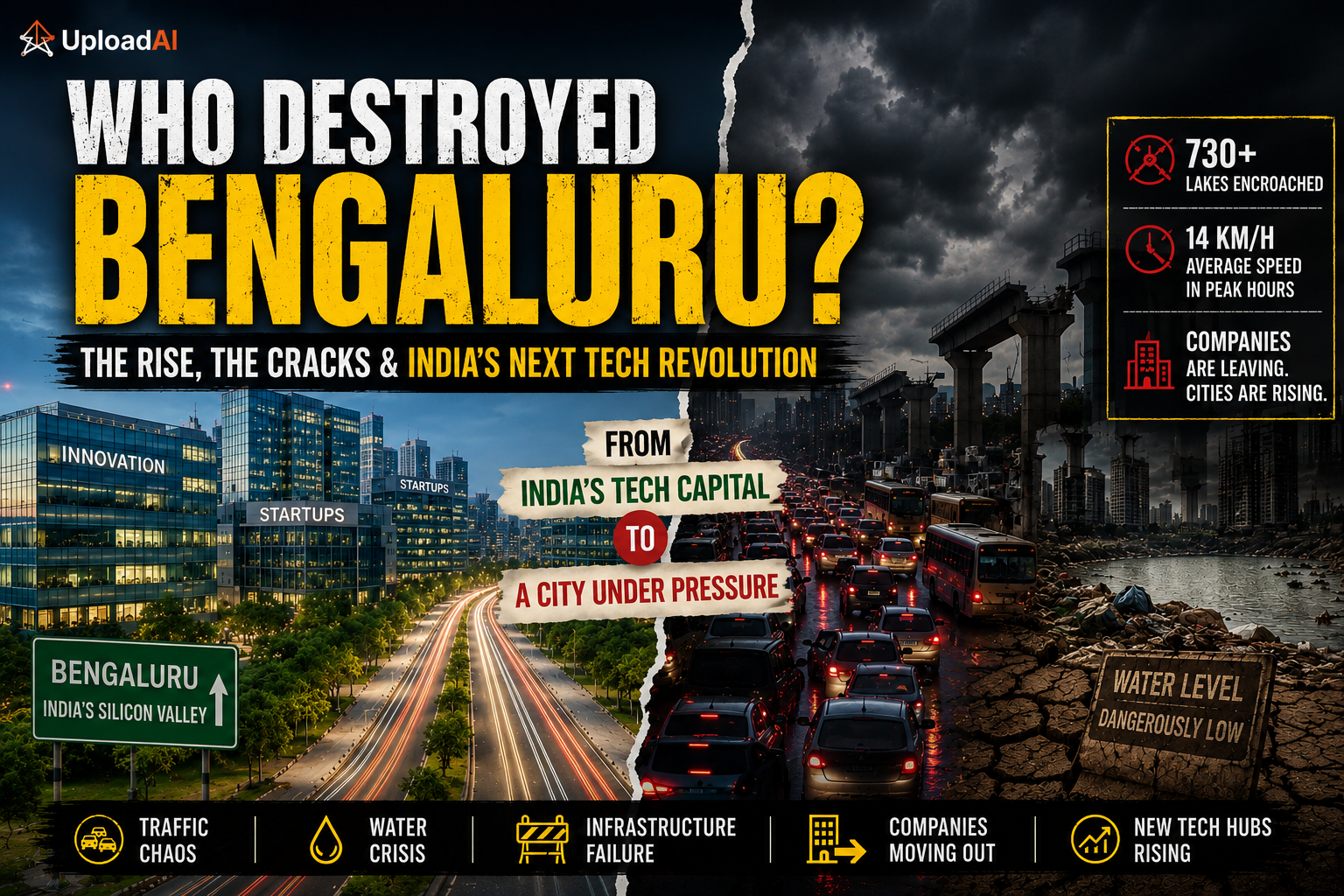
Peak-hour average speed has dropped to nearly 14 km/h.
At this point, a bicycle can sometimes beat your car.
The average Bengaluru professional spends nearly 168 hours every year stuck in traffic.
That’s almost 21 working days lost annually.
And the economic damage?
Nearly ₹20,000 crore every year.
The IT sector alone loses thousands of crores in productivity because people are spending more time on roads than inside offices.
Bengaluru is now one of the most congested cities in the world.
But traffic is still not the biggest problem.
The real crisis is happening underground.
Bengaluru Is Slowly Running Out of Water
This is where things become genuinely serious.
Bengaluru’s groundwater recharge rate has slowed dramatically.
But extraction hasn’t.
In fact, water is now being pulled from the ground almost nine times faster than nature can replenish it.
In several tech corridors:
Borewells are being drilled beyond 1800 feet
Thousands of wells have already dried up
Families are spending ₹15,000–₹25,000 monthly just on water tankers
And then comes the irony.
Karnataka has 32 major data centers.
31 of them are in Bengaluru.
And a single large data center consumes enormous amounts of water every single day just for cooling systems.
Meanwhile, new data centers are still getting approved in zones where groundwater stress has already crossed dangerous levels.
Think about that for a second.
India wants Bengaluru to become a global AI infrastructure hub.
But AI infrastructure needs massive water resources.
And Bengaluru itself is becoming thirsty.
The tragedy becomes even more painful when you realize what the city once was.
A city famous for lakes.
More than 1,600 lakes once existed here.
Today, hundreds have disappeared under illegal encroachments and aggressive real-estate expansion.
Even Bengaluru’s Metro Tells the Story
Infrastructure reveals the truth about a city.
And Bengaluru’s metro story says everything.
Delhi’s metro network stretches close to 390 kilometers.
Bengaluru’s?
Roughly 90 kilometers.
For a city carrying such a massive share of India’s tech economy, that gap is shocking.
Years of delays, fragmented planning, and bureaucratic conflicts have slowed expansion dramatically.
Projects that were supposed to solve congestion often become symbols of dysfunction instead.
Take the Ejipura flyover.
Approved years ago.
Still incomplete.
Meant to reduce traffic.
Now actively contributing to it.
At some point, cities stop scaling because they become too expensive to manage badly.
And Bengaluru may be approaching that point.
The Great Tech Exodus Has Already Started
Then came the moment that shocked India’s corporate ecosystem.
For the first time in decades, Hyderabad overtook Bengaluru in attracting new GCCs.
That wasn’t symbolic.
That was structural.
Even companies born in Bengaluru are now expanding elsewhere.
Because eventually, companies can tolerate high rents.
But they cannot tolerate endless inefficiency.
One recent example perfectly captures what’s happening.
Executives at Bengaluru-based logistics unicorn BlackBuck publicly expressed frustration over potholes and traffic.
Soon after, Andhra Pradesh openly invited companies to move to Vizag — promising:
Faster execution
Better roads
Easier business operations
That comparison perfectly defines India’s next tech battle:
Red carpet vs red tape.
And companies are paying attention.
Hundreds of firms have already shifted operations outside Karnataka over the last few years, especially during Bengaluru’s peak water and traffic crises.
But here’s the important part.
Bengaluru is not dying overnight.
Not even close.
Bengaluru Is Still India’s Deep-Tech King
This is where people misunderstand the story.
Bengaluru still dominates:
AI funding
Venture capital
Deep-tech innovation
Elite engineering talent
Startup density
Globally, it remains one of the world’s strongest startup ecosystems.
But there’s a difference between:
Existing power
Future momentum
In finance, there’s a concept called:
Stock
Flow
Stock is accumulated value.
Flow is future movement.
Bengaluru still has enormous stock:
Talent
Infrastructure
Capital
Reputation
Ecosystem depth
But the flow is changing.
The new investments.
The new expansions.
The new employment hubs.
The new infrastructure bets.
Those are increasingly moving across India.
And honestly?
That’s probably healthy.
India Doesn’t Need One Bengaluru. It Needs Five.
This is the biggest takeaway from the entire story.
Bengaluru is not the villain.
It’s the victim of India’s overdependence.
For decades, India extracted value from one city without building enough parallel ecosystems elsewhere.
No single city can permanently carry the ambitions of a billion people.
India now needs specialized technology hubs:
Hyderabad for large-scale tech operations
Pune for automotive and industrial innovation
Vizag for data infrastructure
Chennai for manufacturing-tech integration
Bengaluru for elite innovation and deep-tech research
That’s how resilient economies are built.
Not through one overloaded megacity.
But through multiple centers of excellence.
A City That Built India’s Tech Dream… Is Now Warning Us About Its Future
In 1985, Texas Instruments made a bet on Bengaluru.
One company trusted one city.
And for the next 40 years, India followed behind it.
That single decision transformed Bengaluru into:
India’s startup capital
India’s GCC hub
India’s engineering powerhouse
The backbone of a $250 billion IT dream
But today, that same city has become one of the most congested urban ecosystems in the world.
More than 730 lakes have been encroached.
Data centers are being approved in regions where groundwater levels are already collapsing.
Traffic is eating productivity.
Infrastructure is struggling to breathe.
And yet, Bengaluru is still expected to carry India’s next AI revolution on its shoulders.
Maybe the biggest tragedy is this:
Bengaluru didn’t fail overnight.
It slowly started bleeding under the weight of India’s dependence on it.
So what do you think?
Is Bengaluru witnessing a temporary phase…
Or are we watching the slow end of India’s one-city tech monopoly?
Bengaluru gave India its first tech dream. Now it's time for India to give something back — not by abandoning it, but by finally building the ecosystem it always deserved around it.
Let us know your thoughts in the comments.
We are UploadAI, and if you enjoyed this deep dive, share it with someone who cares about India’s future.
And for more detailed stories on technology, business, startups, AI, and the future of India — follow UploadAI.
Till then, stay curious. Stay informed. And stay happy.