
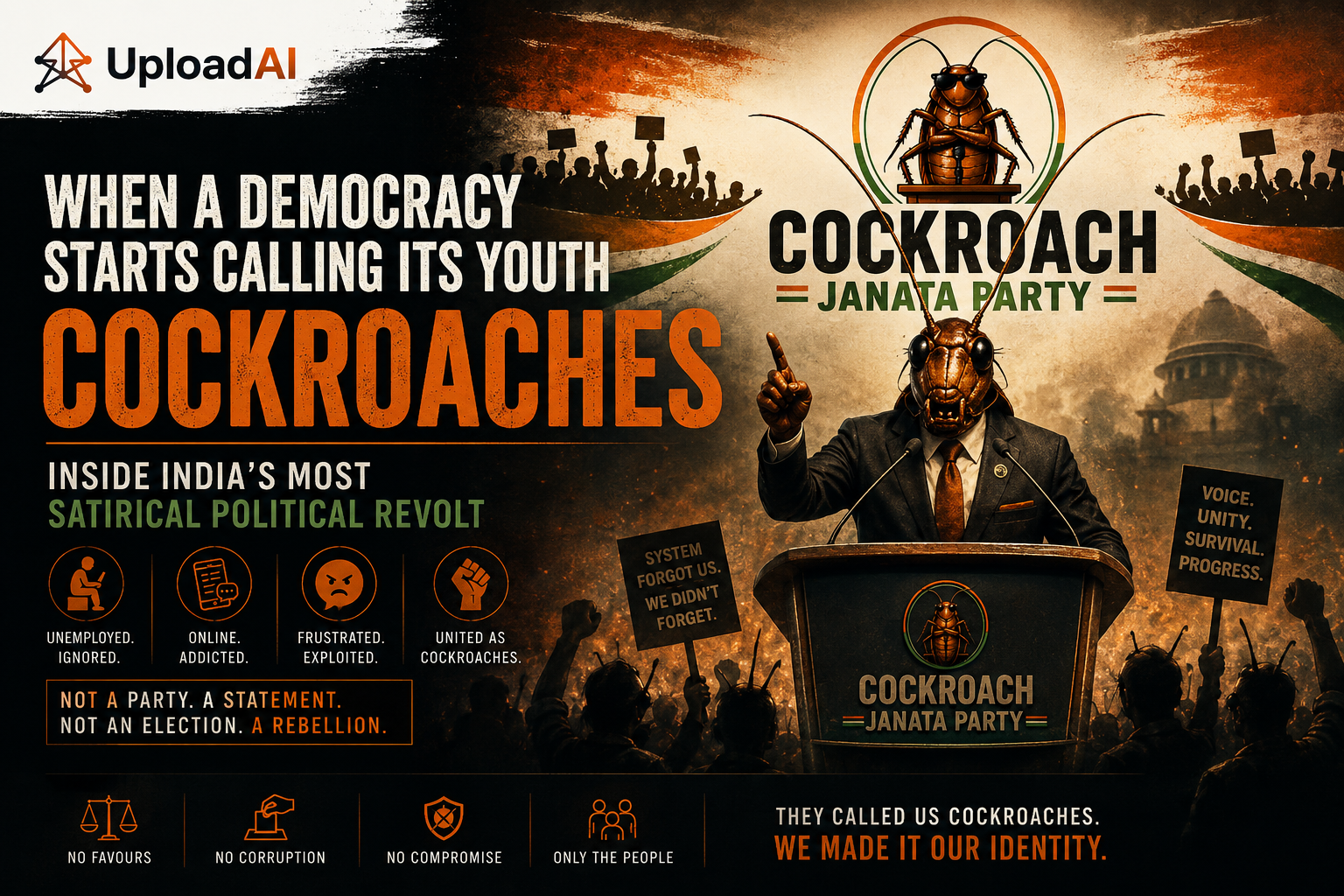
WHEN A DEMOCRACY STARTS CALLING ITS YOUTH “COCKROACHES”
A dark cinematic exploration of the viral “Cockroach Janata Party” and what it reveals about modern democracy, youth frustration, unemployment, and the growing disconnect between institutions and the younger generation. More than political satire, this blog uncovers how sarcasm, internet culture, and rebellion are becoming the language of a generation losing faith in the system.
May 21, 2026 · 4 min read
Every collapsing system eventually creates its own symbolism.
Sometimes it’s protest.
Sometimes it’s silence.
And sometimes…
it’s a cockroach.
Not the insect hiding behind kitchen shelves.
But a political identity.
A satire so dark that it stopped feeling like a joke.
Because somewhere between unemployment, online rage, collapsing trust in institutions, and a generation feeling completely abandoned…
India just witnessed the birth of something called the Cockroach Janata Party.
And strangely enough…
thousands of people wanted to join it.
At first glance, it sounds ridiculous.
A meme.
An internet stunt.
A sarcastic rebellion designed for social media virality.
But beneath the absurdity lies something far more dangerous:
a generation slowly losing faith in the system itself.
And maybe that’s why this story matters.
Because societies don’t randomly create symbols like this.
Symbols emerge when frustration becomes impossible to ignore.
The entire controversy began after a remark linked to India’s Chief Justice, where the term “cockroach” entered public discourse while discussing fake degree holders entering professions like law and media.
Later clarifications followed.
But by then, the internet had already done what the internet always does:
transform outrage into identity.
And on that very day, a man named Abhijeet Dipke announced something bizarre online:
The Cockroach Janata Party.
Not as a real electoral movement.
Not to contest elections.
But as a satirical political outfit designed to mock a system many young people feel has already mocked them first.
And suddenly, the joke exploded.
Because modern political satire no longer survives on humor alone.
It survives on emotional truth.
The qualifications to join this “party” were intentionally absurd:
Be unemployed.
Be lazy.
Stay online all day.
And possess professional-level frustration.
Funny?
Yes.
But also disturbingly accurate.
Because underneath the comedy sits a generation dealing with:
job insecurity,
digital addiction,
political exhaustion,
economic anxiety,
and a growing feeling that nobody powerful is actually listening anymore.
That’s what makes this movement interesting.
Not the name.
The emotion behind it.
The Cockroach Janata Party openly calls itself “the voice of the lazy and unemployed.”
But that sentence carries more psychological weight than people realize.
Because in modern society, unemployment is no longer treated as an economic condition.
It becomes a moral judgment.
People don’t just lose jobs.
They lose dignity.
And eventually, many young people begin feeling invisible inside systems that constantly talk about growth while emotionally disconnecting from the very generation expected to survive inside it.
The party’s creator described the movement as a response to youth humiliation and institutional arrogance.
And honestly…
that’s where the satire becomes dangerous.
Because when institutions stop sounding human,
people stop trusting them emotionally.
That’s when irony becomes rebellion.
And rebellion becomes culture.
The party’s manifesto reads less like governance and more like weaponized frustration.
No post-retirement political rewards for Chief Justices.
Strict punishment for deleted votes.
50% reservation for women instead of symbolic representation.
Crackdowns on corporate-controlled media.
Lifetime political disqualification for party-switching politicians.
Absurd?
Maybe.
But satire becomes powerful precisely because it exaggerates reality just enough to expose what people secretly believe already exists underneath it.
That’s why movements like this spread online so quickly.
Not because people think a cockroach party will run the country…
but because people increasingly feel the current system already stopped representing them.
And perhaps the most symbolic part of all this is the choice of the word “cockroach” itself.
A cockroach survives anything.
It adapts.
It resists.
It keeps crawling through broken systems long after collapse begins.
And maybe that’s exactly how many young people see themselves today.
Ignored.
Mocked.
Economically cornered.
Digitally overstimulated.
Politically unheard.
Yet somehow still surviving.
That’s the real story here.
Not a meme party.
A trust crisis.
Because democracies become unstable long before they collapse politically.
They collapse emotionally first.
The moment citizens stop believing they matter…
the system begins decaying from the inside.
And right now, across much of the world, young people increasingly feel:
unheard,
unseen,
and psychologically disconnected from institutions that still expect obedience from them.
That frustration is no longer staying private.
It’s turning into satire.
Into irony.
Into internet movements.
Into anti-establishment humor.
Into digital rebellion.
And history has always shown something dangerous:
When people stop expressing anger seriously…
they begin expressing it comedically.
That’s usually when the anger has gone deeper than politics.
So no, the Cockroach Janata Party may never become a real political force.
But it represents something real:
a generation adapting to dysfunction instead of believing the system will fix itself.
And perhaps that should worry institutions far more than any slogan ever could.
Because once people emotionally detach from the system…
they stop trying to reform it.
They simply start mocking it.
And that is often the beginning of something much bigger.
If this article made you think differently about modern politics, youth frustration, or the growing trust crisis inside democracy, support the blog with a like and share your perspective below. And if this resonated with you, share it with someone who still believes satire is “just comedy.”
Because sometimes the darkest jokes reveal the deepest truths.
— UploadAI