
The Day You Say “I Have Insurance”… Everything Changes. The Dark Secrets of Private Hospitals
Behind the polished walls of private hospitals lies a disturbing reality most people never see. From insurance scams and unnecessary surgeries to inflated bills and profit-driven treatments, this cinematic investigation uncovers how fear and trust are sometimes exploited in healthcare — through real stories, whistleblower accounts, and shocking evidence.
May 20, 2026 · 10 min read
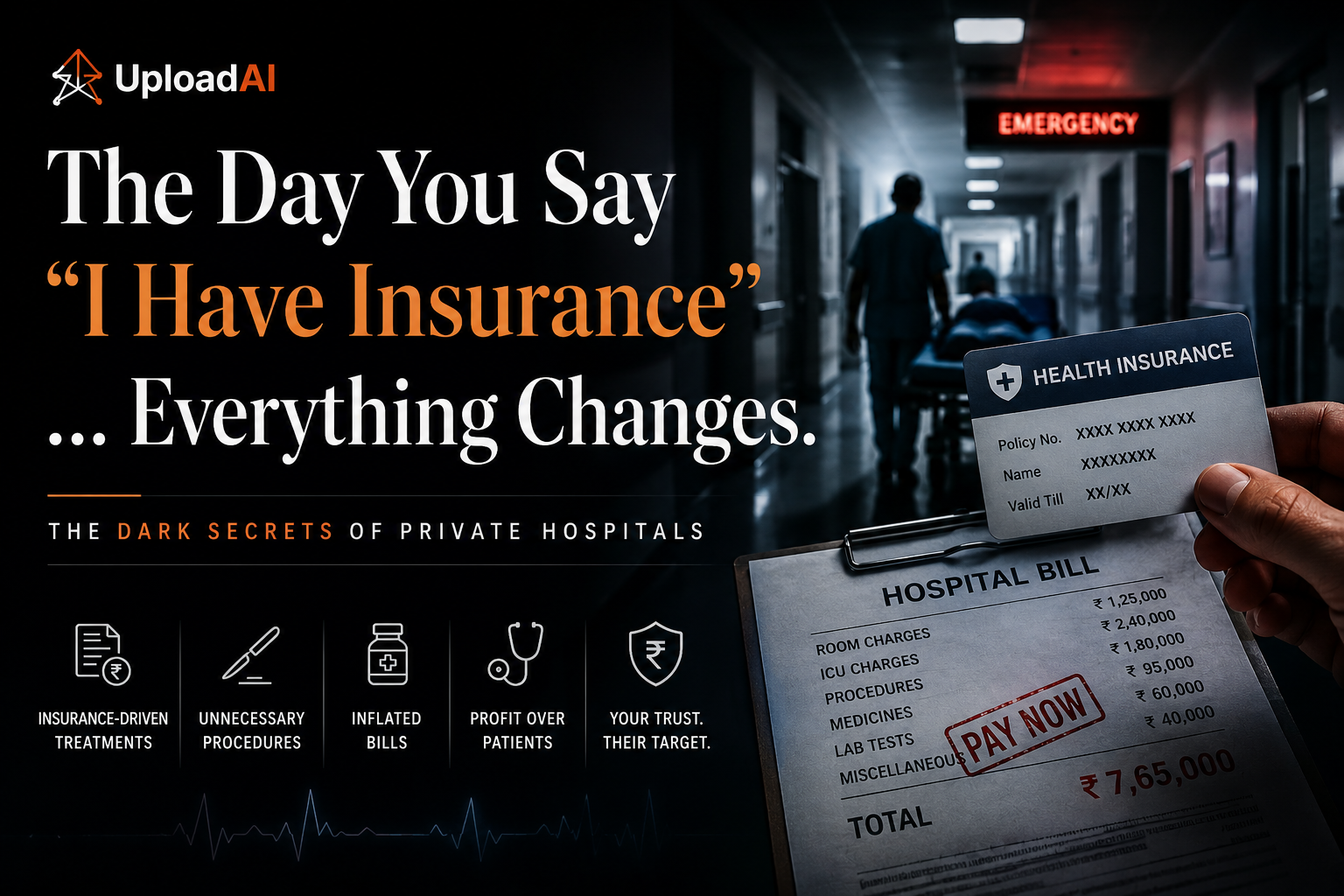
There are some places we walk into with complete trust.
Hospitals are one of them.
We trust the white coat.
We trust the smiling receptionist.
We trust the machines, the reports, the signatures, the “Don’t worry, we’re handling it.”
But what if, the moment you say “I have health insurance”…
…you stop becoming a patient,
and start becoming a business opportunity?
Today, I want to take you through some of the most disturbing hospital scams happening openly across India — scams backed not by conspiracy theories, but by reports from the NITI Aayog, the Competition Commission of India (CCI), parliamentary committees, investigative journalism, whistleblower doctors, and heartbreaking real-life cases.
And no — this isn’t about blaming doctors.
Many doctors themselves are trapped inside a system where corporate targets matter more than human lives.
This is the story of what happens when healthcare slowly turns into a profit machine.
And once you see it…
…it becomes impossible to unsee.
The Insurance Trap
In 2020, Himanshu Singhal took his two-and-a-half-year-old son Siddharth to a large corporate hospital in Shalimar Bagh.
The child had loose motions.
Nothing life-threatening.
No emergency.
No panic situation.
A routine condition.
But according to Himanshu, everything changed the moment the hospital staff discovered he had a cashless health insurance policy.
Suddenly, there was pressure to admit the child.
Not suggest.
Pressure.
Like many parents would, Himanshu agreed. After all, when doctors insist, most families assume they know best.
What happened next still haunts him.
According to his statements, the hospital began extending the child’s stay under the name of “protocol.” Himanshu later alleged that the planning inside the hospital wasn’t about recovery anymore — it was about prolonging treatment.
“They planned how they could keep my child admitted for the longest possible time.”
Then came a shocking diagnosis.
The child was reportedly diagnosed with acute anal fissure after what Himanshu described as negligent observation from a distance. Soon after, the child was prescribed Movicol — a medicine generally used to treat constipation.
But Siddharth already had loose motions.
Then came the moment that changed everything.
Himanshu alleged that medication meant to be given orally was administered intravenously.
“Instead of giving the medicine orally, they injected it directly into my child’s bloodstream.”
Within hours, the child began passing uncontrollable urine and stool. By evening, severe dehydration had reportedly pushed his condition into catastrophic decline.
And then came another push.
A liver transplant.
Imagine being a father hearing that your child suddenly needs a liver transplant for a condition that began as loose motions.
On February 9th, around 9:30 in the morning, Siddharth died.
But according to Himanshu, even after his child’s death, the hospital’s focus remained on billing clearance.
Later, broken and crying, he said something that shook the internet:
“If I didn’t have insurance, maybe they would never have admitted my son… and maybe he would still be alive.”
Pause for a second and think about that.
A father believed insurance may have made his child more profitable than curable.
And this wasn’t an isolated allegation.
When Patients Become Revenue Targets
In the book Dissenting Diagnosis, interviews with 78 doctors revealed something deeply uncomfortable:
Many doctors admitted facing pressure from management to prescribe tests based on a patient’s insurance limit.
Not medical necessity.
Insurance limit.
The Competition Commission of India has also stated in reports that some private hospitals inflate room rents and diagnostic costs specifically for insured patients.
Some hospitals have even been blacklisted over unethical billing practices.
Yet the system continues.
And that leads us to one uncomfortable reality:
The moment hospitals know your coverage limit, some begin treating your insurance ceiling as a spending target.
So here’s something important:
Before immediately disclosing insurance at reception, first:
consult the doctor,
understand the diagnosis,
ask for the estimated treatment cost,
and only then proceed with insurance formalities.
Because transparency changes behavior.
The Admission Scam
A doctor once quit a corporate hospital on the first day of work.
Why?
Because she witnessed something horrifying.
According to her account, the hospital owner — who was not even a physician — personally decided:
which patients would be admitted,
who would be shifted to ICU,
and how long they would stay there.
Not based on urgency.
Based on occupancy.
“She decided every patient who would be admitted… and every admitted patient had to be kept in ICU for as long as possible.”
She described an environment where ICU beds were treated like hotel rooms that must never remain empty.
And that connects to another alleged practice insiders call:
The Weekend Occupancy Scam
Imagine this.
A patient gets admitted on Thursday.
Doctors say:
“You’ll probably be discharged by Saturday.”
Saturday arrives.
Suddenly:
“Senior doctor isn’t available.”
“Insurance clearance won’t come today.”
“Billing department is closed.”
“Let’s observe one more day.”
And somehow the patient remains trapped until Monday.
Extra room rent.
Extra monitoring charges.
Extra consultation fees.
Extra pharmacy billing.
The CCI’s policy note from 2018 explicitly discussed how hospitals may delay patient exits to maximize profits through unfair trade practices.
The most disturbing part?
Most families never realize it’s happening.
Because fear makes people obedient.
And hospitals know that.
The C-Section Business
Now let’s talk about one of the most emotionally sensitive areas in healthcare:
Childbirth.
Every mother dreams of a safe delivery.
Most families prefer normal delivery whenever medically possible.
But in many private hospitals, C-sections have quietly become a business model.
Why?
Because a normal delivery can take anywhere between 6 to 18 hours.
A C-section?
Roughly 45 minutes.
Faster.
More predictable.
Far more profitable.
And this is where Abhilash and his wife Sakshi enter the story.
They visited a large private hospital in Noida during Sakshi’s pregnancy. According to Abhilash, everything appeared normal during checkups.
“Everything was normal. We did every checkup the hospital asked us to do.”
A healthy pregnancy can naturally go up to 40 weeks.
But the hospital allegedly claimed there was low amniotic fluid and admitted Sakshi during the 38th week.
Without waiting for natural labor, a C-section was performed.
The baby, born early, was shifted to the NICU.
“They immediately took the baby away saying he was too weak.”
But then things spiraled.
During surgery, something reportedly went terribly wrong.
Sakshi began experiencing severe internal bleeding. Her condition deteriorated rapidly.
According to the family, they were kept in the dark while hospital staff allegedly took signatures on blank papers.
Then came a devastating revelation.
Without proper consent, Sakshi’s uterus had reportedly been removed.
Soon after, the hospital referred her to Apollo, where doctors allegedly discovered her organs were failing.
Within hours, Sakshi died.
But the nightmare didn’t end there.
Because the premature baby also did not survive.
Imagine walking into a hospital expecting to welcome a new life…
…and walking out having lost both your wife and child.
No words can truly hold that kind of pain.
Why So Many C-Sections?
Even celebrities have spoken about similar experiences.
TV actress Chhavi Mittal revealed in an interview that she was allegedly given an oxytocin injection without informed consent to induce labor pain.
“The moment the injection was administered, I suddenly got a panic attack. My throat went dry. My heart started racing. I started shaking instantly.”
And families across India hear similar lines every day:
“The baby has passed stool.”
“The cord is wrapped around the neck.”
“The baby could suffocate.”
“Fluid levels are low.”
“We can’t take the risk.”
“The baby’s head is too large.”
“The cervix isn’t opening.”
Now let’s be very clear:
Sometimes these situations are absolutely real.
Emergency C-sections save lives every single day.
But here’s the shocking part.
According to the WHO, only about 10–15% of births generally require C-sections medically.
In Indian government hospitals, the rate roughly aligns with that range.
But in private hospitals?
Some reports show rates climbing close to 49%.
In states like Telangana, Jammu & Kashmir, and West Bengal, some private institutions have reportedly approached nearly 80%.
That means in some places, normal delivery is becoming the exception.
And this issue goes beyond childbirth.
Reports have alleged that:
55% of heart surgeries,
48% of uterus surgeries,
48% of knee replacements,
and 45% of C-sections
may be medically unnecessary.
Just pause and absorb that.
Because behind every unnecessary surgery is a frightened family trusting someone blindly.
The Sink Test Scam
Now imagine this.
You visit a corporate hospital with mild fever.
One blood test would have been enough.
But after consultation, you’re handed a long list:
liver profile,
thyroid panel,
vitamin analysis,
multiple scans,
advanced diagnostics.
You pay thousands.
You give blood samples.
And according to renowned cardiologist Dr. B.M. Hegde, some unethical labs have allegedly engaged in something called the “sink test.”
Here’s how it allegedly works:
One necessary test is actually performed.
The remaining blood samples?
Discarded into the sink.
Fake reports are generated anyway.
Why?
Because diagnostics are one of the most profitable verticals in healthcare.
And behind this lies another dark ecosystem:
The Referral Commission Network
In 2017, Income Tax raids on diagnostic labs in Bangalore reportedly uncovered:
₹1.5 crore cash,
and several kilograms of gold.
Investigations allegedly revealed large-scale referral commission systems.
Doctors, clinics, and hospitals referring patients to labs in exchange for incentives.
Now referrals themselves are not inherently wrong.
Every industry has partnerships.
The problem begins when unnecessary referrals are driven by commissions instead of patient need.
Former Apollo Hospital nephrologist Dr. M.K. Mani once openly described referral commissions as an “open secret.”
Even leaked documents from elite hospitals reportedly showed structured payouts tied to patient referrals.
Think about what that means.
Your illness becomes someone else’s sales funnel.
“Are We Doctors… Or Salesmen?”
One doctor described the pressure like this:
“Management says ICU beds must be filled. Operation theatres shouldn’t remain empty. Admit OPD patients whether necessary or not. Are we doctors or insurance salesmen completing quotas?”
That sentence captures the heart of the crisis.
Not all doctors are unethical.
Far from it.
Many entered medicine to save lives.
But corporate systems increasingly evaluate hospitals using:
occupancy,
revenue,
procedures,
and billing targets.
Healthcare becomes KPI-driven.
And when healing becomes secondary to quarterly numbers…
humanity suffers.
The Medicine Scam
Now let’s talk about something almost every Indian family has experienced:
Overpriced medicines.
Investigations exposed alleged nexuses involving major pharmaceutical companies and hospitals.
Hospitals purchase medicines in bulk at discounted rates…
…and then sell them to patients at massive markups.
In some cases:
300%.
500%.
Even 900%.
A medicine costing the hospital ₹1,950 was reportedly billed to patients at over ₹18,000.
Another drug bought for ₹3,190 allegedly appeared in bills as ₹16,500.
The margins are staggering.
And actor Aamir Khan highlighted another shocking truth years ago:
“A medicine that costs ₹117 under a branded name can sometimes be available as a generic for less than ₹2.”
Same salt.
Same composition.
Massive price difference.
Yet many patients are subtly pushed toward expensive in-house pharmacy purchases.
Why?
Because pharmacies inside hospitals are often huge revenue engines.
But here’s what many people don’t know:
You absolutely have the right to buy medicines from outside pharmacies.
And generic medicines from Jan Aushadhi Kendras can reduce costs dramatically.
The myth that “cheap generic medicines don’t work” is largely misinformation.
The active ingredient — the salt — remains the same.
Even journalist Palki Sharma once highlighted this clearly:
“Doctors were told to stop prescribing branded drugs and prescribe generic medicines instead. It’s essentially the same drug.”
The ₹16 Lakh Dengue Bill
In 2017, seven-year-old Aadya Singh was admitted to a hospital in Gurugram with dengue.
She remained hospitalized for 15 days.
Sadly, she did not survive.
But what happened after her death shocked the country.
Her parents received a bill of nearly ₹16 lakh.
Investigations later revealed bizarre charges:
hundreds of syringes,
thousands of gloves,
hospital gowns,
thermometers,
massively inflated consumables.
Items worth ₹5–₹6 were allegedly billed at over ₹100.
Routine blood tests costing ₹100 outside allegedly appeared as ₹5,400 inside.
This is why itemized billing matters.
Always ask for:
full breakdowns,
quantity details,
medicine MRPs,
consumable charges,
and justification for expensive procedures.
The moment hospitals realize you’re auditing the bill carefully…
behavior changes.
The Ventilator Scam
And now we come to perhaps the darkest allegation of all.
The ventilator scam.
Multiple investigative reports and legal observations have raised concerns about cases where brain-dead or deceased patients were allegedly kept on ventilators to continue billing families.
Imagine losing someone…
…but not even being told immediately because the billing meter is still running.
One reported case involved a woman allegedly kept on ventilator support for three days after death.
Another involved a child reportedly maintained for nearly a month despite being technically brain-dead.
Ventilator beds are among the most expensive assets in hospitals.
And when profit enters end-of-life care…
ethical lines begin disappearing.
So Why Is This Happening?
Three major reasons.
1. Corporatization of Healthcare
In many large hospitals, doctors now work under management structures driven by business targets.
Revenue goals.
Occupancy targets.
Procedure numbers.
Medicine becomes corporate performance.
2. Weak Regulatory Enforcement
Parliamentary committees themselves have criticized regulatory bodies for failing to adequately enforce ethical conduct.
Rules exist.
Implementation often doesn’t.
3. Public Unawareness
Most people simply do not know their rights.
Few know:
they can ask for itemized bills,
seek second opinions,
refuse unnecessary procedures,
demand written consent explanations,
or buy medicines outside.
And systems thrive when consumers stay uninformed.
But Here’s The Most Important Thing
This article is not anti-doctor.
Let’s make that absolutely clear.
India has incredible doctors.
Dedicated doctors.
Ethical doctors.
Doctors who work impossible hours and save lives every day.
Many of them are victims of this system too.
The real problem begins when healthcare stops being about healing…
…and starts behaving like an industry optimized for extraction.
Because the moment profits become more important than patients…
trust dies first.
And once trust dies inside hospitals…
society loses something far bigger than money.
Before You Leave…
The next time you enter a hospital:
ask questions,
demand clarity,
read every document,
seek second opinions,
verify bills,
and never confuse fear with urgency.
Because awareness may not solve everything.
But awareness can stop you from becoming helpless.
And in today’s healthcare system…
that awareness might one day save a life.
Maybe even your own.
If this article opened your eyes, support it by liking and share it with someone you love.
Because sometimes the most dangerous scams are the ones hiding behind trust.
— UploadAI