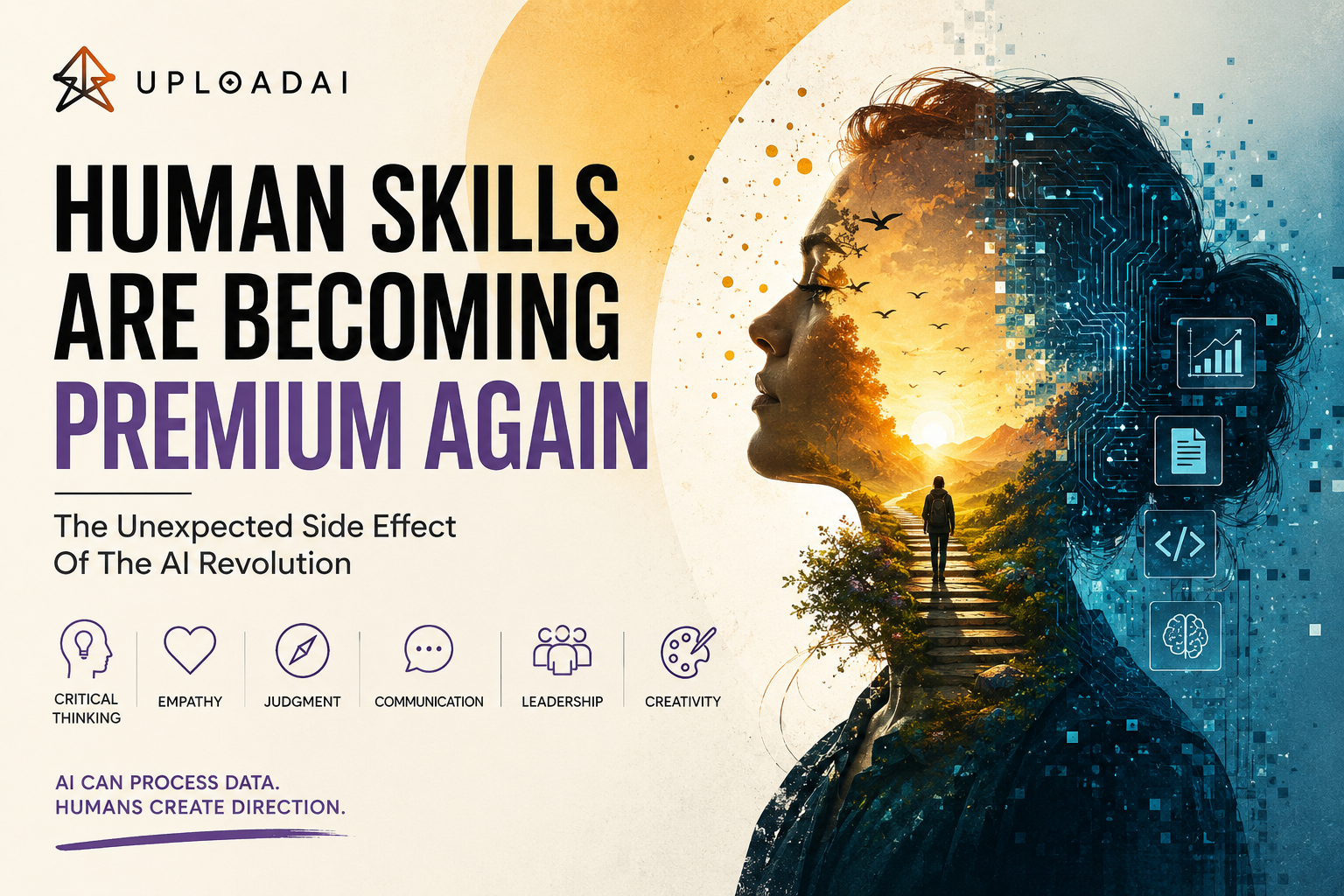
Human Skills Are Becoming Premium Again - The Unexpected Side Effect Of The AI Revolution
Artificial Intelligence is making knowledge, content, and execution more accessible than ever before. But as AI becomes increasingly capable, a surprising trend is emerging: uniquely human skills are becoming more valuable. This article explores why critical thinking, creativity, communication, judgment, and empathy may become the most sought-after abilities of the AI era—and why the future belongs to those who know how to combine technology with distinctly human strengths.
June 18, 2026 · 3 min read
For years, the conversation around artificial intelligence has been dominated by one question:
"Which jobs will AI replace?"
It's a reasonable concern.
AI can now write emails.
Generate images.
Analyze data.
Create presentations.
Write code.
Summarize research.
Translate languages.
And perform tasks that once required highly skilled professionals.
Naturally, many people assumed that as machines became more capable, human value would decline.
But something unexpected is happening.
The more powerful AI becomes, the more valuable certain human skills appear to be.
Not less valuable.
More.
This may become one of the biggest economic shifts of the next decade.
For most of modern history, access to knowledge created advantage.
If you knew more than others, you could create more value.
The internet expanded access to information.
AI is expanding it even further.
Today, knowledge is becoming increasingly abundant.
Anyone can ask an AI system to explain a complex topic, generate ideas, summarize reports, or help solve problems within seconds.
The barrier to information is collapsing.
And when something becomes abundant, it becomes less differentiating.
That doesn't mean expertise disappears.
It means the source of competitive advantage begins to shift.
The question is no longer:
"What do you know?"
The question is becoming:
"What can you do with what you know?"
This is where human skills become increasingly important.
Consider two people using the same AI tools.
One produces average results.
The other creates exceptional outcomes.
The technology is identical.
The difference is human judgment.
One person knows which questions to ask.
Which ideas to pursue.
Which risks to avoid.
Which opportunities matter.
Which decisions deserve attention.
AI can generate options.
Humans still choose directions.
And direction is often more valuable than execution.
This pattern is already visible across industries.
Companies are increasingly looking for skills that machines struggle to replicate:
Critical thinking.
Creativity.
Communication.
Leadership.
Empathy.
Decision-making.
Adaptability.
Trust.
These skills are difficult to automate because they depend on context, nuance, and human understanding.
An AI can draft a message.
But trust still closes deals.
An AI can generate content.
But taste determines what resonates.
An AI can provide answers.
But judgment determines which answers matter.
Perhaps the biggest misconception about AI is the belief that technology primarily rewards technical expertise.
Technical skills remain important.
But as AI lowers the cost of execution, the value of higher-order thinking increases.
When everyone has access to powerful tools, outcomes depend less on the tool itself and more on the person using it.
History offers an interesting parallel.
The invention of calculators did not eliminate mathematicians.
Spreadsheets did not eliminate finance professionals.
Search engines did not eliminate researchers.
Instead, these technologies shifted human effort toward higher-value activities.
AI may do the same.
According to the World Economic Forum's Future of Jobs research, analytical thinking, creativity, resilience, leadership, and lifelong learning are expected to become increasingly important in the years ahead.
Not despite AI.
Partly because of it.
This creates an unexpected opportunity.
The future may not belong to the people who know the most.
It may belong to the people who think the best.
The people who can combine technology with judgment.
Data with wisdom.
Information with perspective.
Automation with empathy.
Because the real challenge of the AI era isn't generating answers.
It's knowing which answers deserve attention.
Technology is becoming smarter.
That part is obvious.
What is less obvious is that humans may need to become more human in response.
The qualities that once felt secondary are becoming strategic advantages.
The ability to communicate clearly.
Build trust.
Understand people.
Navigate uncertainty.
Make decisions.
Think independently.
These are no longer soft skills.
They are becoming premium skills.
At UploadAI, we explore how technology is reshaping human behavior, work, culture, and society.
Because understanding the future isn't just about understanding artificial intelligence.
It's about understanding what remains uniquely human.
And as AI continues to transform the world, one thing is becoming increasingly clear:
The future may belong not to those who compete with machines.
But to those who master what machines cannot replace.