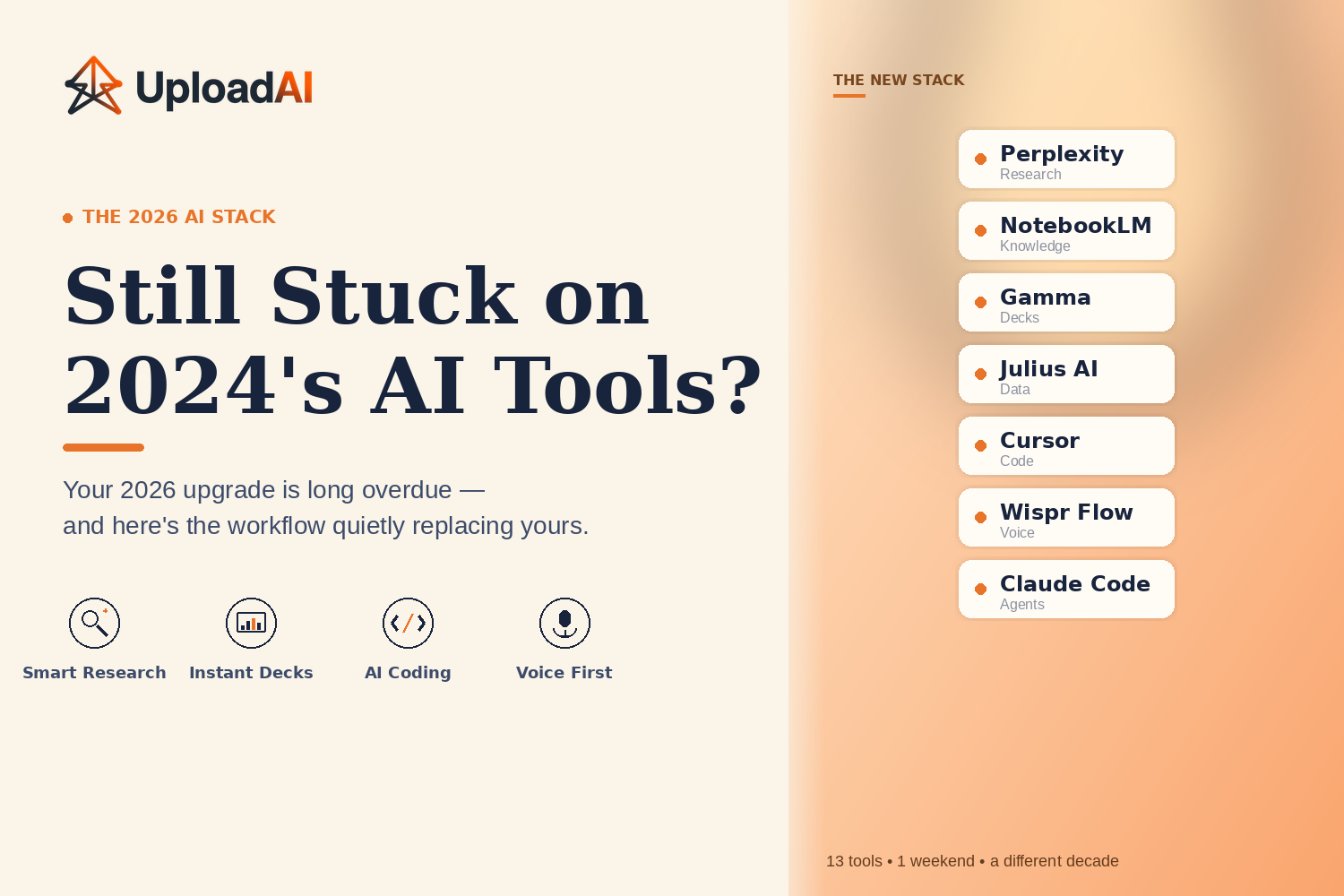
Still Stuck on 2024's AI Tools? Your 2026 Upgrade Is Long Overdue.
Inside the quiet revolution rewriting how the world's best knowledge workers spend their day.
June 23, 2026 · 6 min read
It's 11:47 AM on a Wednesday. Two analysts in the same Bengaluru office tower, working on the same brief.
Priya has fourteen browser tabs open. She's still scrolling through page two of Google results, hunting for that one McKinsey report her director mentioned in the morning sync. She'll find it in twenty minutes. Skim it for forty. Copy three quotes into a PowerPoint deck that she'll spend the rest of the afternoon making "look presentable."
Three desks away, Rohan is done.
He asked Perplexity for the report. Pasted the link into NotebookLM. Asked for the three takeaways most relevant to his sector. Dropped those into Gamma. Forty minutes later, his deck looked like a McKinsey deck. Forty minutes.
It's now 12:30 PM. Rohan is on his second coffee. Priya is opening tab number fifteen.
Same job. Same degree. Same number of years on the books.
Different decade.
The Stack Has Changed. Most People Haven't.
Here's the thing nobody is saying loud enough: 2026 isn't a year. It's a workflow upgrade. And it's already here.
The tools that defined "being good at your job" in 2024 — Google, ChatGPT, Excel, PowerPoint, Premiere, Photoshop — still work. Of course they do. But they've quietly slipped into the same category as fax machines and clip art. Functional. Tolerated. Replaced in any serious workflow.
What replaced them isn't one new tool. It's a constellation. And the gap between someone running the 2024 stack and someone running the 2026 one isn't 10%. It's 5x. Sometimes 10x. Sometimes the difference between getting promoted and getting quietly skipped over for someone twice as fast.
Let me show you the new stack — not as a list, but the way it actually shows up in someone's day.
09:00 AM — The Research Hour That Used to Take All Morning
In 2024, your morning started with Google. In 2026, it starts with Perplexity.
You don't search anymore. You ask. "What were the three biggest moves in the Indian defence sector last week, and which analysts are bullish?" Four seconds. A sourced answer. Three follow-up questions. Done before your coffee gets cold.
Heavy reading? You drop the PDFs into NotebookLM and ask questions in plain English. A twenty-page healthcare policy white paper becomes three bullet points and a page reference in thirty seconds. The librarians of the world just got a quiet superpower — and most of them don't even know it yet.
By 10 AM, you've done what used to be a full morning of work. By 10:15, you're already designing the deck.
11:00 AM — The Deck That Used to Eat Your Day
In 2024, decks were a punishment. Blank slide. Blinking cursor. Three hours and forty-seven font changes later, something passable.
In 2026, Gamma writes the first draft from a prompt. Beautiful templates. Smart layouts. You spend your time editing the story, not nudging text boxes by two pixels. The deck that used to take three hours now takes thirty minutes — and looks better than the one your manager paid a contractor for last quarter.
If it's a quick visual you need, Ideogram or Krea types out a draft in seconds. The "I'll just hack something together in Illustrator" era is over for anything that isn't pixel-perfect production work.
12:30 PM — Excel Got a Co-pilot. It's Better Than You Expected.
Don't worry. Excel isn't dead. It's still where the numbers live.
But sitting beside it now is Julius AI. You type, in plain English, "plot revenue by region for Q2, highlight the outliers, and tell me what changed from Q1." It builds the chart. It writes the commentary. You sip your coffee.
The analysts who outperform in 2026 aren't the ones who quit Excel. They're the ones who stopped pretending pivot tables were a personality.
02:00 PM — Coding Got Weird (In the Best Way)
If you write code: GitHub Copilot was 2024. In 2026, developers live inside Cursor and Claude Code — tools that don't just suggest the next line, they refactor entire codebases while you're in a meeting.
Not a typo. While you're in a meeting.
You hand the agent a task before standup. By the time the call ends, the pull request is sitting in your inbox. You review. You merge. You move on to the next thing.
The autocomplete era is over. The delegation era has begun.
03:30 PM — The Quiet Death of the Keyboard
Wispr Flow turns your voice into typed text at 150 words per minute. Perfect punctuation. Proper capitalization. It learns how you talk and matches your style. After one day, you stop opening your keyboard for emails. After one week, you wonder how anyone ever typed long documents at all.
Got a long video? OpusClip turns an hour of footage into ten vertical shorts — captioned, cropped, ready to post. Captions handles the rest. The "I'd post more but I don't have an editor" excuse just expired.
And Then There's the Part Nobody's Talking About
Here's where it gets genuinely interesting.
Every "2025 → 2026 tools" post you've seen this week is missing the same thing: agents.
The real shift isn't a one-for-one tool swap. It's the rise of AI that doesn't just assist — it runs entire workflows while you do something else.
Claude Code refactors your repository overnight. You wake up to a clean PR.
Manus runs a multi-step research project, on its own, for hours, and shows up at lunch with a finished report.
Operator-style agents book your flights, fill your forms, chase your inbox, and tee up your day before you're even at your desk.
By December, the question you'll get asked won't be "what AI tool do you use?" It'll be "how many agents do you have running right now?"
That gap — between people who use AI as a tool and people who use it as a workforce — is the real divide of 2026.
A Few Things the Internet Got Wrong This Week
Quick housekeeping, because precision matters. You'll see a chart floating around LinkedIn claiming a tidy "2025 → 2026" swap for every category. Most of it's right. Some of it isn't.
Claude didn't replace ChatGPT. Both are 2026 daily drivers. Smart professionals use both. Pick a primary, stay flexible.
Replit didn't kill VS Code. Different jobs. Replit is for "I want this idea live by tonight." VS Code with Cursor is still where serious software ships from.
Arc Browser is fading, not winning. The real 2026 browser story is Dia and Comet — both with agents built in.
Lead generation didn't move to Prospeo. It moved to Clay, the platform turning prospecting into a programmable workflow.
These aren't pedantic corrections. They're the difference between sounding like you read about 2026 and sounding like you live in it.
So Where Does That Leave You?
Back to Priya and Rohan.
By 5 PM, Rohan has finished his brief, replied to fourteen emails (dictated, of course), shipped a side-project commit to GitHub, and left for the gym.
Priya is still in the office. She'll send her deck at 11:47 PM. Her director will open it the next morning, scan it for thirty seconds, and ask why it took so long.
She won't have a good answer. Because the honest one is: she's still using 2024's tools to do 2026's job.
That's the gap. That's the upgrade. And it's not coming — it already happened.
The good news? It takes one weekend.
Pick three tools from this article. Use them this week. Not next month. This week. By next Friday, you'll wonder why you ever worked any other way.
The 2024 stack still works.
But nobody's hiring it anymore.
Liked this? Follow UploadAI for more deep-dives on the tools, models, and workflows quietly rewriting how the world's best professionals work in 2026.