A 30-Second Joke Started A National Debate - Are We Becoming Too Sensitive Or More Responsible?
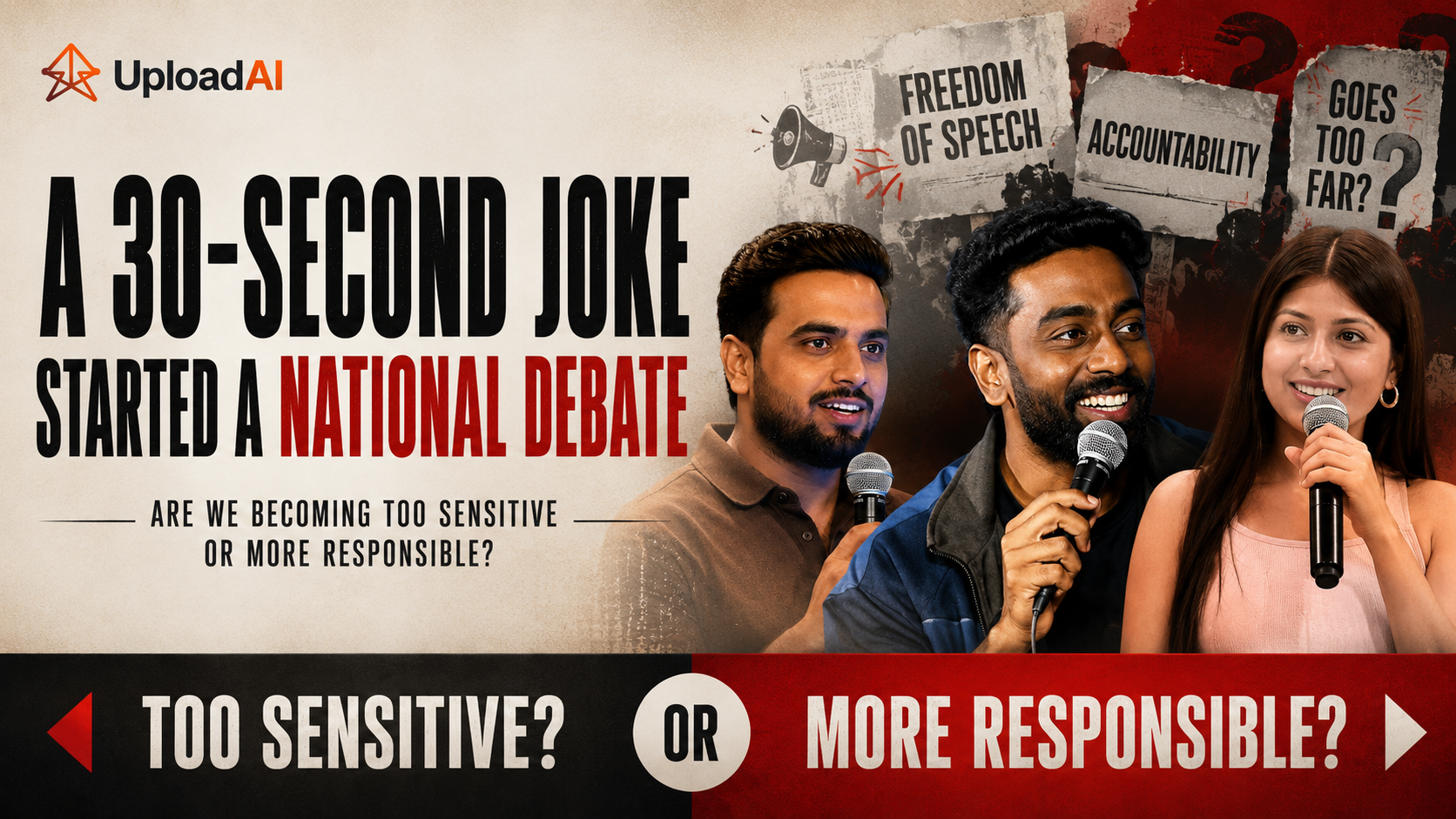
What started as a moment inside a comedy show quickly became a national conversation about comedy, accountability, social media, and where society should draw the line. But beneath the outrage and opinions lies a bigger question: are we becoming too sensitive, or are we simply demanding more responsibility from the voices that shape culture?
June 14, 2026 · 3 min read
A few years ago, this would have ended as just another night at a comedy show.
A comedian on stage.
A microphone passed around the audience.
A joke.
A laugh.
Maybe a few people feeling uncomfortable.
And then everyone goes home.
Instead, millions of people ended up debating it online.
A 30-second clip.
That's all it took.
Not a full show.
Not a full conversation.
Not the context.
Not what happened before.
Not what happened after.
Just 30 seconds.
And suddenly the internet was divided.
Some people were angry.
Some defended the joke.
Some questioned the audience.
Some questioned the comedian.
Others questioned society itself.
But while everyone was debating the joke, I found myself thinking about something else.
Why does this keep happening?
Because this isn't the first time.
And it definitely won't be the last.
A podcast clip.
A stand-up clip.
A classroom clip.
A celebrity interview.
A random street interaction.
Every week, another moment escapes its original environment and becomes a national discussion.
The internet has created a strange new reality.
We no longer experience events.
We experience clips of events.
A generation ago, if someone told a controversial joke, the audience in that room became the audience.
Today, the audience is potentially everyone.
And that's where things become complicated.
Because content now travels much faster than context.
The people watching online weren't there.
They don't know the atmosphere.
They don't know the intent.
They don't know whether the room laughed for thirty seconds or stayed silent for thirty minutes.
All they see is the moment that survived the algorithm.
And the algorithm doesn't reward context.
It rewards reaction.
The stronger the reaction, the further the clip travels.
Which creates an uncomfortable question.
When a joke reaches millions of people, should it still be treated like a joke told inside a room?
Or does it become something bigger?
Many people would argue that public content deserves public accountability.
That words matter.
That jokes influence culture.
That what we normalize eventually shapes society.
And honestly, that's not an unreasonable position.
But there's another side too.
Because comedy has always existed in uncomfortable territory.
The purpose of comedy isn't always to make people comfortable.
Sometimes it's to challenge assumptions.
Sometimes it's to cross boundaries.
Sometimes it fails.
And sometimes the audience disagrees.
That's part of the process.
Which leaves us with a question that feels bigger than this particular controversy.
Are we becoming too sensitive?
Or are we becoming more responsible?
The truth is, both arguments seem to contain something worth listening to.
Perhaps we are more aware than previous generations of how language affects people.
Perhaps we are also less tolerant of mistakes than previous generations.
Perhaps social media has made accountability easier.
Perhaps it has also made outrage easier.
Maybe both things can be true at the same time.
The more I think about it, the less this feels like a debate about comedy.
It feels like a debate about modern society.
A society where every joke can be recorded.
Every opinion can be clipped.
Every moment can be shared.
And every person can become part of a national conversation without ever expecting to.
The internet promised to give everyone a voice.
It succeeded.
What nobody fully understood was that it would also give everyone an audience.
And maybe that's the real question hidden underneath this controversy.
Not whether the joke was right.
Not whether the joke was wrong.
But whether we're still learning how to live in a world where every conversation is only one viral clip away from becoming everyone's business.