
Nobody Has Time To Think Anymore - And It's Quietly Changing Human Creativity
We live in a world where every spare moment is filled with content. The moment boredom appears, we reach for our phones. But what if boredom was never the problem? This article explores how technology is eliminating mental downtime, why some of humanity’s best ideas emerged from moments of stillness, and how a world that never stops consuming may be quietly changing the way we think, create, and innovate.
June 16, 2026 · 3 min read
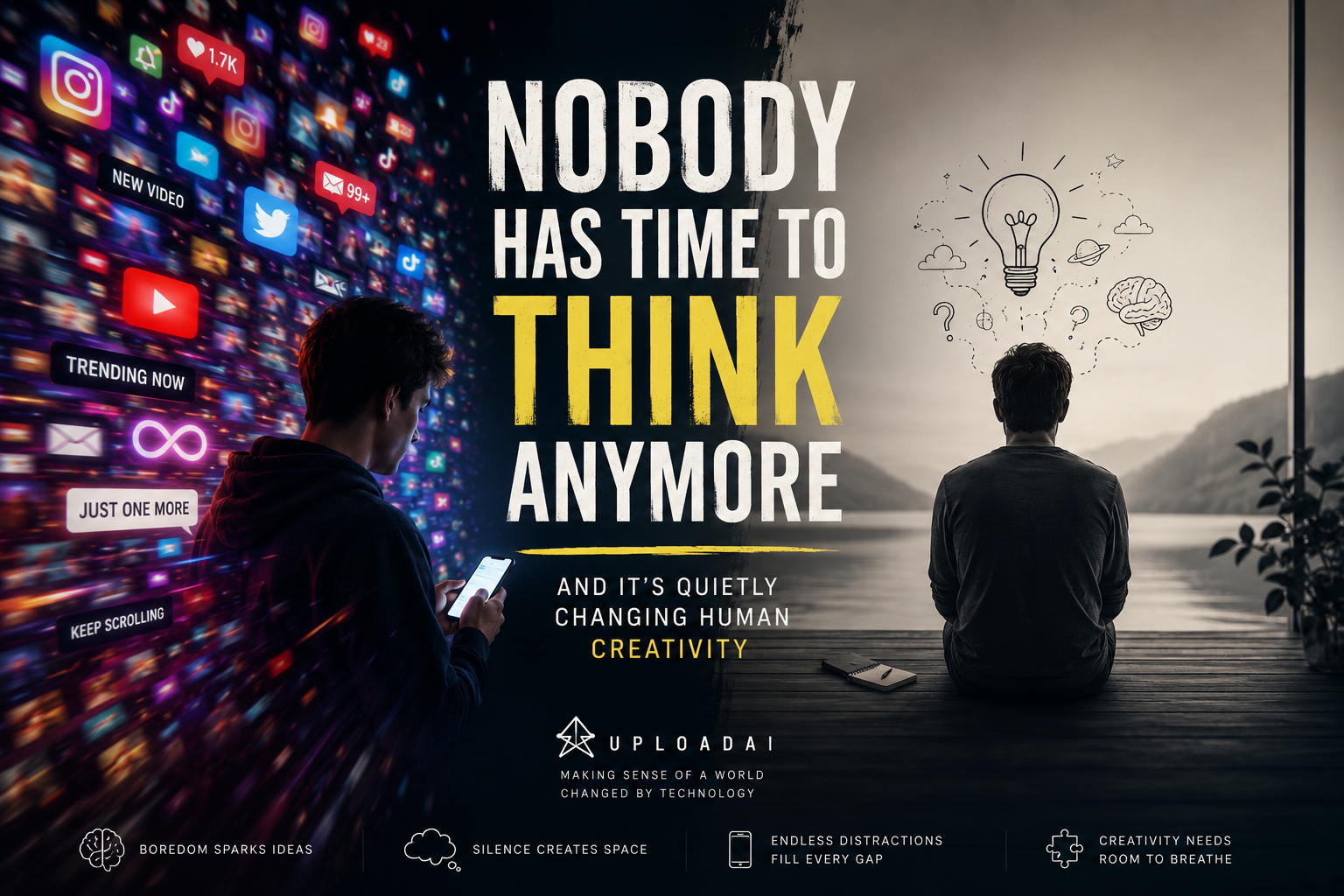
There was a time when boredom was unavoidable.
People stared out of train windows.
Waited in long lines.
Sat quietly before meetings.
Walked without headphones.
Drove without podcasts.
Waited without touching a screen.
And during those seemingly unproductive moments, something important happened.
They thought.
Ideas formed.
Problems got solved.
Connections appeared.
Creativity emerged.
For most of human history, boredom wasn't a problem.
It was a feature of being human.
Today, boredom is disappearing.
And few people realize what we may be losing along with it.
The average internet user now spends more than six hours online every day, according to DataReportal. Smartphones ensure that nearly every moment of waiting, silence, or downtime can instantly be filled with content.
A few seconds at a traffic signal.
A queue at a coffee shop.
A quiet evening.
A moment of uncertainty.
The response is almost automatic.
Open Instagram.
Open YouTube.
Open LinkedIn.
Open TikTok.
Open X.
Open ChatGPT.
Open something.
Anything.
Modern technology has become extraordinarily good at eliminating boredom.
But creativity has always depended on it.
Many psychologists have long argued that moments of mind-wandering play an important role in creative thinking. When the brain is not focused on immediate tasks, it enters what researchers call the "default mode network"—a state associated with imagination, reflection, memory, and idea generation.
In simple terms:
Some of our best thinking happens when we're not actively trying to think.
That's why breakthrough ideas rarely arrive while staring at a spreadsheet.
They arrive:
During a walk.
In the shower.
While travelling.
While waiting.
During moments of mental space.
Boredom creates that space.
Technology often removes it.
This creates an interesting paradox.
Humanity has access to more information than ever before.
Yet many people feel less creative.
More informed.
But less original.
More connected.
But less reflective.
Every day, people consume hundreds of ideas.
Articles.
Videos.
Podcasts.
Posts.
News.
Opinions.
Advice.
Content has become infinite.
The challenge is that creativity requires more than consumption.
It requires processing.
Reflection.
Silence.
Time.
And those are becoming increasingly rare.
A study published in the journal Science famously found that many participants preferred mild electric shocks over being left alone with their thoughts for a short period of time.
That finding may sound surprising.
But it highlights something important:
Modern humans have become uncomfortable with mental stillness.
Technology didn't create this tendency.
It amplified it.
Today, every moment of discomfort can be instantly escaped.
Feeling bored?
Scroll.
Feeling anxious?
Watch something.
Feeling uncertain?
Refresh the feed.
The result is a world where attention is constantly occupied.
But creativity needs empty space.
Imagine a farmer planting seeds every day but never allowing anything to grow.
That's increasingly how many people consume information.
Input after input.
Content after content.
Without enough time for ideas to take root.
The consequence isn't immediate.
It's subtle.
People become better consumers.
But weaker thinkers.
Better at reacting.
But worse at reflecting.
Better at following trends.
But worse at creating original ones.
Perhaps this helps explain why so many people feel mentally exhausted despite spending so much time consuming information.
The brain was designed to process experiences.
Not absorb an endless stream of them.
The solution is not abandoning technology.
Technology remains one of the greatest tools humanity has ever created.
The solution is creating room for boredom again.
Not because boredom feels good.
But because it creates the conditions for thinking.
For creativity.
For reflection.
For originality.
The future may not belong to people who consume the most information.
It may belong to those who can still find time to think about it.
At UploadAI, we explore how technology is reshaping human behavior, work, culture, and society.
Because the most important question about technology isn't what it can do.
It's what it's doing to us.
And in a world where every second is filled with content, perhaps the rarest luxury is no longer information.
It's uninterrupted thought.