
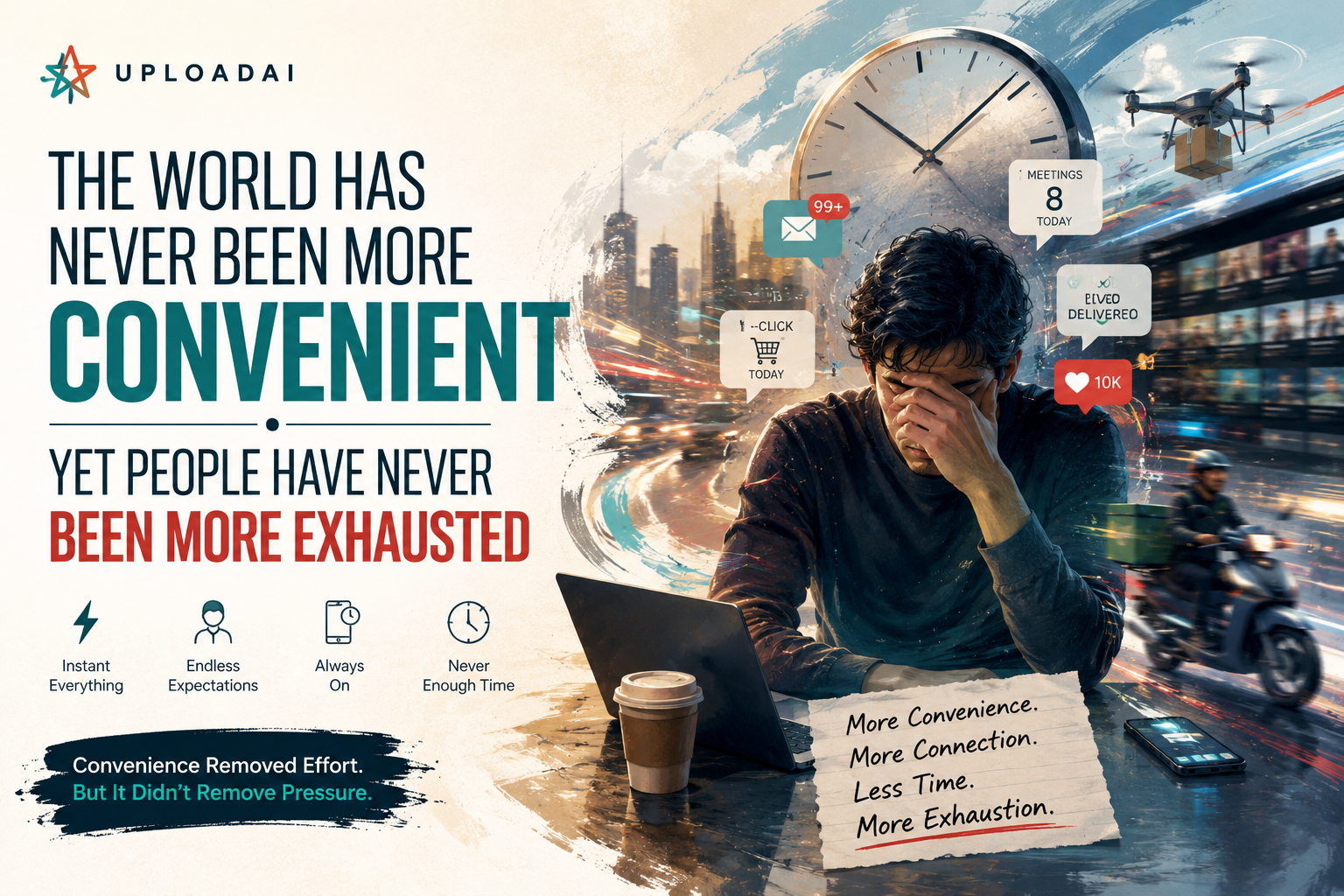
The World Has Never Been More Convenient - Yet People Have Never Been More Exhausted
Technology has made life faster, easier, and more convenient than ever before. From instant communication and food delivery to AI-powered productivity, many of the frictions of everyday life have disappeared. Yet despite all this convenience, people seem more overwhelmed, stressed, and exhausted than ever. This article explores the hidden tradeoff of a frictionless world and why convenience alone may not be the same as freedom, fulfillment, or well-being.
June 20, 2026 · 3 min read
Human history has been a story of removing friction.
We built cars so we could travel faster.
Search engines so we could find information instantly.
Smartphones so we could stay connected anywhere.
Food delivery so we wouldn't have to cook.
Streaming services so we wouldn't have to wait.
Online shopping so we wouldn't have to visit stores.
Artificial intelligence so we could complete tasks in seconds.
For centuries, technology has promised the same thing:
Make life easier.
And in many ways, it has succeeded.
The average person today can accomplish tasks in minutes that once took hours, days, or even weeks.
Need information?
Search it.
Need transportation?
Tap a button.
Need food?
Tap a button.
Need entertainment?
Tap a button.
Need help writing, researching, designing, or learning?
Ask AI.
Never before in human history has so much convenience been available to so many people.
Yet something strange is happening.
Despite living in the most convenient era ever created, people seem increasingly exhausted.
Not physically.
Mentally.
Emotionally.
Psychologically.
According to global workplace studies, burnout, stress, and feelings of overwhelm continue to rise across many industries, particularly among younger generations entering a highly connected digital world.
That raises an uncomfortable question:
If technology keeps saving us time, why don't we feel like we have more of it?
Part of the answer lies in how humans respond to convenience.
When technology removes friction, it rarely removes expectations.
It often increases them.
Emails replaced letters.
Communication became faster.
But now people expect replies immediately.
Smartphones made work portable.
But work followed people home.
Video meetings eliminated travel.
But calendars became packed with back-to-back calls.
Productivity software improved efficiency.
But efficiency often became the new baseline.
The time saved was rarely returned.
It was reinvested.
Then optimized.
Then expected.
Technology solved old problems.
But it also created new standards.
And humans adapted quickly.
What once felt extraordinary soon became normal.
What once felt convenient became expected.
What once felt optional became mandatory.
This pattern appears everywhere.
Streaming removed waiting.
Now people struggle to choose from endless options.
Social media removed communication barriers.
Now people feel pressure to stay constantly connected.
Online shopping removed inconvenience.
Now next-day delivery feels slow.
Artificial intelligence reduces effort.
Yet many professionals feel increasing pressure to produce more.
Convenience solved friction.
It did not solve pressure.
In some cases, it amplified it.
Psychologists call this adaptation.
Humans quickly become accustomed to improvements and begin treating them as normal.
The result is that every breakthrough feels transformative at first.
Then invisible.
Then insufficient.
A faster world does not automatically become a calmer world.
In fact, it can become the opposite.
Because every layer of convenience often creates another layer of expectation.
The ability to do more becomes the expectation to do more.
The ability to respond faster becomes the expectation to respond faster.
The ability to work anywhere becomes the expectation to work everywhere.
And eventually people find themselves living in a world optimized for efficiency but struggling to find space for recovery.
Perhaps the problem isn't that technology failed.
Technology has delivered extraordinary benefits.
People live longer.
Learn faster.
Connect globally.
Access opportunities previous generations could never imagine.
The challenge is that convenience and well-being are not the same thing.
Removing effort does not automatically create fulfillment.
Saving time does not automatically create freedom.
Efficiency does not automatically create peace of mind.
The modern world has become exceptionally good at helping people do more.
The harder question is whether it helps them feel better.
Perhaps that's the next challenge of the digital age.
Not building technology that saves time.
But learning how to use the time it saves.
At UploadAI, we explore how technology is reshaping human behavior, work, culture, and society.
Because understanding the future isn't just about understanding what technology can do.
It's about understanding how technology changes the way people live.
And perhaps one of the most important questions of our time is this:
If the world keeps becoming more convenient, why do so many people still feel exhausted?