
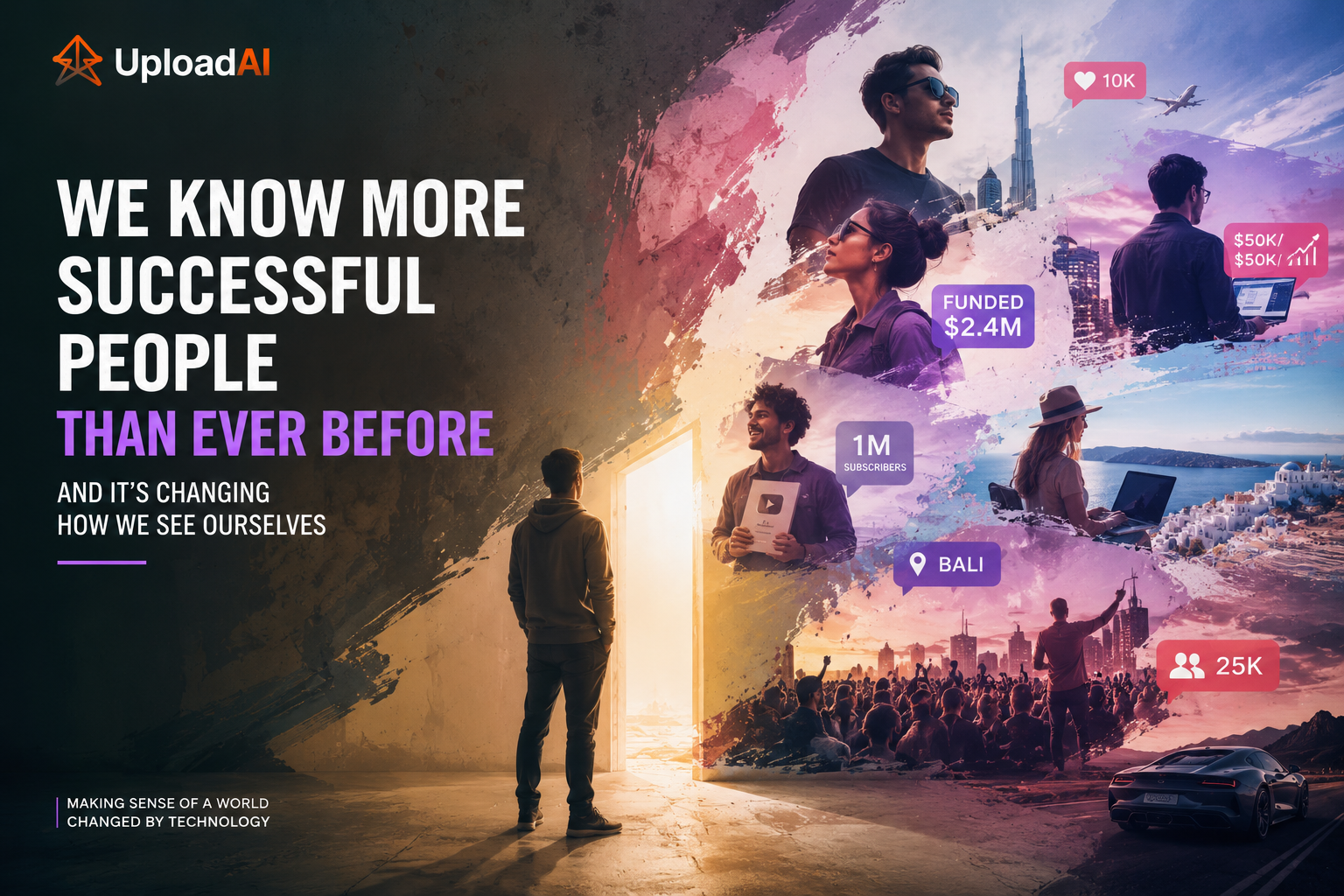
We Know More Successful People Than Ever Before And It's Changing How We See Ourselves.
The internet has given people access to more success stories than any generation in history. Every day, we witness founders raising millions, creators building audiences, entrepreneurs launching businesses, and professionals reaching new milestones. But constant exposure to success is quietly changing how people see themselves. This article explores how technology transformed human comparison, why so many people feel behind despite having more opportunities than ever, and the hidden psychological shift shaping modern ambition.
June 15, 2026 · 3 min read
For most of human history, success was local.
You compared yourself to your classmates.
Your colleagues.
Your neighbors.
Your relatives.
The people around you defined what success looked like.
If someone became wealthy, everyone knew their story.
If someone built a successful business, it was rare enough to become a local legend.
If someone achieved something extraordinary, it felt extraordinary.
Then the internet arrived.
And suddenly, the definition of success stopped being local.
Today, before most people finish breakfast, they can see:
A founder raising millions.
A creator crossing a million followers.
A teenager building an AI startup.
A freelancer earning more than corporate executives.
A digital nomad working from another continent.
An entrepreneur selling a company.
A professional announcing a promotion.
A student getting into a dream university.
For the first time in human history, billions of people have access to the achievements of people they have never met.
The internet didn't just connect humanity.
It connected humanity's ambitions.
And that is changing how people see themselves.
According to DataReportal, the average internet user now spends more than six hours online every day. Much of that time is spent consuming content about careers, businesses, lifestyles, achievements, and personal success from people all over the world.
At first glance, this seems like a good thing.
And in many ways, it is.
The internet has democratized opportunity.
People can learn skills online.
Build businesses.
Find remote work.
Create content.
Launch startups.
Access knowledge that previous generations could only dream of.
The modern internet has created more opportunities than any generation has ever experienced.
But every revolution comes with unintended consequences.
The same technology that expanded opportunity also expanded comparison.
A recent Deloitte Global Gen Z and Millennial Survey found that financial concerns, career progression, and future uncertainty remain among the biggest stress factors for younger generations worldwide.
That may seem strange.
After all, people today have more access to information, opportunities, and resources than ever before.
So why do so many feel behind?
Because success is no longer occasional.
It's constant.
Every scroll reveals someone achieving something remarkable.
A funding announcement.
A new job.
A product launch.
A viral creator.
A revenue milestone.
A success story.
And over time, something subtle happens.
Extraordinary achievements stop feeling extraordinary.
They start feeling normal.
The internet compresses years of effort into a few seconds of content.
People see the outcome.
Not the process.
The celebration.
Not the sacrifice.
The result.
Not the struggle.
A founder's ten-year journey becomes a LinkedIn post.
A creator's thousands of failed videos become a thirty-second highlight reel.
An entrepreneur's decade of uncertainty becomes a single headline.
The context disappears.
Only the achievement remains.
And when people repeatedly see achievements without context, expectations begin to shift.
What once felt exceptional starts to feel expected.
What once felt inspiring starts to feel ordinary.
And what once felt impossible starts to feel late.
That may be one of the most important psychological consequences of the internet age.
Not because people are becoming less successful.
But because they are constantly exposed to more success than any generation before them.
Research from the American Psychological Association has consistently linked social comparison on digital platforms to increased stress, anxiety, and reduced life satisfaction, particularly among younger users.
The problem is not ambition.
Ambition has built companies, innovations, careers, and progress.
The problem is perspective.
Because the internet quietly created a world where people compare their everyday lives to the highlights of thousands of others.
And no human brain was designed for that.
Yet despite all of this, the answer is not to disconnect from the world.
The internet remains one of humanity's greatest tools.
It has created opportunities, careers, businesses, communities, and possibilities that previous generations never had.
The challenge is learning how to consume success without allowing it to redefine your self-worth.
To learn from other people's journeys without turning them into personal scoreboards.
To use visibility as inspiration instead of measurement.
Because perhaps the greatest gift of the internet is access.
But perhaps the greatest skill of the modern age is perspective.
At UploadAI, we explore how technology is quietly reshaping human behavior, ambition, work, culture, and society.
Because understanding the future isn't just about understanding technology.
It's about understanding what technology is doing to people.
And if this article resonated with you, share it with someone who has ever felt behind while scrolling through a world full of success stories.
They may not be behind at all.
They may simply be seeing more success than any generation in human history.