
AMAZON’S ASHRAY IS NOT CHARITY The Dark Strategy Behind Amazon’s Expansion of Worker Welfare in India
Amazon says Ashray is about helping delivery workers survive India’s brutal heat. But behind the air-conditioned rest centres, free water, and welfare messaging lies something much bigger: labour laws tightening across India, rising gig worker unrest, massive delivery-worker attrition, and a corporate giant quietly protecting itself before the system forces it to. This article uncovers why Ashray may not be charity at all — but one of the smartest corporate survival strategies unfolding in modern India.
May 23, 2026 · 5 min read
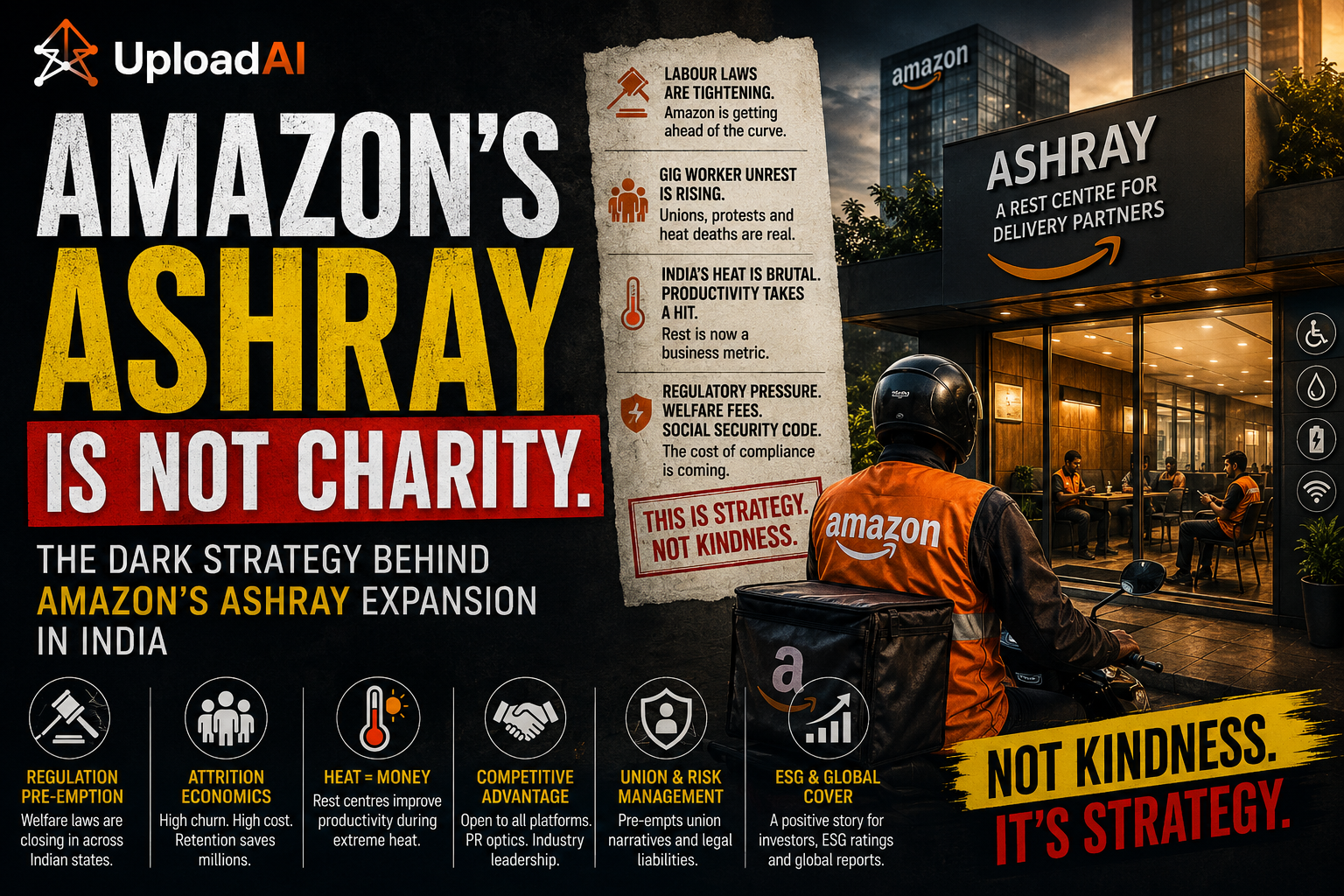
At 2:17 PM, somewhere in Delhi, a delivery worker parks his bike beside a small air-conditioned room.
Outside, the road is melting under 45-degree heat.
Inside:
cold water,
charging points,
washrooms,
a chair,
a few minutes of relief.
The room is called Ashray.
And at first glance, it looks beautiful.
Human, even.
In a country where millions of gig workers spend their lives inhaling dust, surviving traffic, and delivering convenience to people sitting in air-conditioned homes, the idea feels almost revolutionary.
A corporation finally caring about workers.
At least…
that’s the story being sold.
But the deeper you look into Amazon’s Ashray expansion across India, the less it begins to feel like charity…
and the more it starts looking like one of the smartest corporate survival strategies modern India has ever seen.
Because Ashray is not just a rest stop.
It is infrastructure.
And infrastructure is power.
That’s the real story.
For years, India’s gig economy operated inside a strange illusion.
Millions of workers powered:
food delivery,
quick commerce,
e-commerce,
ride-sharing,
and last-mile logistics…
without being treated like traditional employees.
No guaranteed protections.
No meaningful social security.
No stability.
No long-term safety net.
Yet the platforms kept growing.
Faster deliveries.
More orders.
More convenience.
More investor excitement.
Until governments finally started paying attention.
And suddenly, the regulatory walls began closing in.
Rajasthan introduced India’s first gig worker law.
Karnataka followed with welfare fees, algorithm transparency requirements, grievance mechanisms, and worker protections.
Other states began moving in the same direction.
Even the central government started discussing social security frameworks for gig workers tied to aggregator platforms.
Translation?
The era of “infinite flexible labour with minimal responsibility” is slowly ending.
And Amazon knows it.
That changes everything.
Because once regulations arrive, companies face a dangerous question:
Do they wait for governments to force compliance…
or do they build their own version of worker welfare first?
Amazon chose the second option.
Not because corporations suddenly became emotional.
But because smart corporations understand something governments often don’t:
Perception shapes regulation.
Ashray is brilliant because it allows Amazon to quietly say:
“Look, we are already solving the problem.”
And that changes the conversation entirely.
Now regulators don’t just see a trillion-dollar tech company.
They see:
rest centres,
hydration stations,
worker welfare campaigns,
cooling zones,
shelter infrastructure.
The optics become powerful.
Especially in a country where public infrastructure itself often struggles to support labourers.
And this is where the story becomes darker.
Because the moment corporations begin providing things society failed to provide…
people emotionally start trusting corporations more than systems.
That shift is incredibly dangerous.
Not because Ashray is evil.
But because dependency changes power structures.
A delivery worker who depends on Amazon for income is one thing.
A delivery worker who depends on Amazon for:
rest,
safety,
water,
charging,
heat survival,
and dignity…
is something entirely different.
That’s no longer just employment.
That’s ecosystem control.
And Amazon understands ecosystems better than almost any company on Earth.
But the strategy goes even deeper than regulation.
India’s gig economy has a hidden crisis few people talk about enough:
attrition.
Workers leave constantly.
The churn rate in last-mile delivery is brutal.
And every lost worker costs:
recruitment,
verification,
training,
productivity ramp-up,
and operational instability.
Now imagine what happens during Indian summers.
A dehydrated delivery associate moves slower.
Fails more deliveries.
Takes longer routes.
Makes more mistakes.
Feels more exhausted.
Eventually quits.
Suddenly, air-conditioned rest centres stop looking like kindness.
They start looking like logistics optimization.
Because in modern capitalism, human exhaustion is measured financially.
That’s the uncomfortable truth most companies never openly admit.
The body becomes data.
Heat becomes inefficiency.
Rest becomes throughput engineering.
Even hydration becomes a business metric.
And perhaps the smartest part of Amazon’s strategy is this:
Ashray isn’t limited only to Amazon workers.
That detail changes everything.
By allowing workers from Swiggy, Zomato, Blinkit, Zepto, and other platforms to use these centres, Amazon achieves something psychologically genius.
It positions itself as:
the responsible giant,
the humanitarian platform,
the adult in the room.
Now competitors look reactive instead of visionary.
And the public narrative shifts.
Suddenly, Amazon no longer looks like just another aggressive corporation.
It starts looking like infrastructure itself.
That distinction matters more than people realize.
Because history shows something dangerous:
The most powerful corporations are not the ones selling products.
They are the ones people begin depending on emotionally and structurally.
That’s when corporations stop behaving like companies…
and start behaving like parallel systems.
And perhaps the most fascinating part of Ashray is that it arrives at the exact moment global criticism against Amazon’s labour practices continues rising elsewhere.
Warehouse injury reports.
Worker surveillance.
“Pee bottle” allegations.
Union battles.
Burnout narratives.
Globally, Amazon has spent years fighting an image problem around labour exploitation.
Ashray helps rewrite the story.
Now investor presentations can showcase:
worker welfare,
heat protection,
community infrastructure,
sustainability initiatives,
human-centric logistics.
This is not accidental.
Modern corporations understand something terrifyingly well:
Narrative management is as important as operational management.
Especially in the age of ESG investing and public scrutiny.
And that’s why the ₹2,800 crore number matters psychologically.
Large numbers create moral legitimacy.
But behind the headlines lies a colder corporate calculation:
Retention savings.
Regulatory cushioning.
PR insulation.
Labour stability.
Political goodwill.
Competitive advantage.
This is not philanthropy.
This is strategic self-preservation operating at planetary scale.
And honestly…
that does not automatically make it bad.
That’s what makes the story complicated.
Because the truth is:
workers genuinely benefit from Ashray.
In brutal Indian summers, these centres can absolutely protect health and dignity.
For many delivery workers, a cold room and clean water are not luxuries.
They are survival tools.
And maybe that’s the real tragedy hidden underneath this entire story.
The fact that one of the world’s largest corporations now appears more capable of building worker survival infrastructure than the systems originally designed to protect labour itself.
That should make society deeply uncomfortable.
Because once corporations become more trusted than public institutions…
power quietly changes hands.
Not through elections.
Through dependency.
And perhaps that is the future modern capitalism is slowly moving toward:
A world where corporations no longer just sell services…
but become the systems human beings emotionally and economically rely on to survive.
Ashray may look like a rest stop.
But in reality, it may be something much bigger:
a glimpse into how Big Tech plans to govern the future of labour itself.
If this article made you think differently about Amazon, the gig economy, and the future of corporate power, support UploadAI with a like and share your thoughts below. And if this resonated with you, share it with someone trying to understand how quietly the future of work is being redesigned around us.
Follow UploadAI on Instagram and LinkedIn for more cinematic deep dives into AI, technology, business, and the systems shaping modern society.
— UploadAI