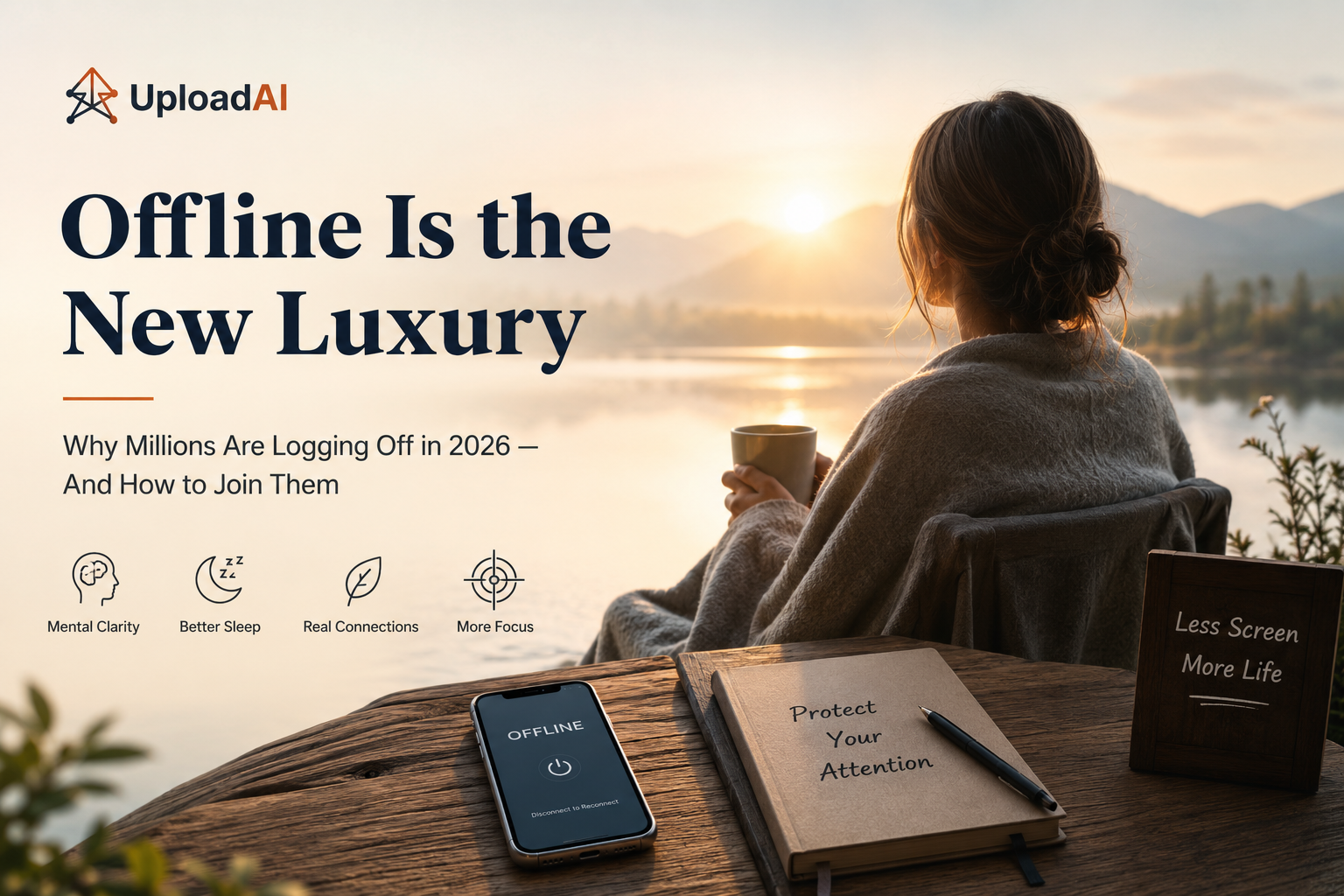
Offline Is the New Luxury: Why Millions Are Logging Off in 2026 — And How to Join Them
In 2026, going offline is no longer a luxury reserved for retreats and vacations — it is becoming a survival skill. As AI-generated content, endless notifications, and dopamine-driven apps dominate daily life, millions are intentionally reducing screen time to reclaim focus, sleep, mental clarity, and real-world connection. This article explores the rise of the digital detox movement, why Gen Z is leading it, and practical ways to build a healthier relationship with technology in an always-online world.
May 14, 2026 · 11 min read
You wake up before your alarm. It is 6:43 in the morning and the room is still dark and quiet. For approximately four seconds, you simply exist — groggy, warm, present. Then your hand moves. It is not a conscious decision. It happens the way breathing happens. The phone is in your hand before your brain has formed a single deliberate thought, and the day, before it has even properly started, has already been handed over to a feed of other people's opinions, breaking news, and things you did not ask to feel anxious about.
If that sequence sounds familiar, you are not alone. You are, in fact, in the overwhelming majority.
The average person now spends somewhere between six and seven hours each day looking at screens — not including time spent working at a computer. In India, where smartphone penetration has grown faster than almost anywhere else on earth, that number sits even higher. We are living through the most screen-saturated period in human history, and something interesting is happening as a result: a growing number of people are choosing, deliberately and sometimes expensively, to put it all down.
Logging off has become the lifestyle trend of 2026. And it is considerably more interesting than it sounds.
From FOMO to JOMO: The Cultural Shift Rewriting How We Live
For roughly a decade, the dominant anxiety of the connected age was FOMO — the Fear of Missing Out. The idea that somewhere, at any given moment, something was happening that you were not part of. That the feed was moving forward without you. That the group chat had seventeen new messages. That the algorithm had surfaced something you would absolutely want to see, if only you looked.
FOMO was enormously profitable for the companies that understood it. Social media platforms were architected around it. Notification systems were engineered to exploit it. The result was a generation of people who checked their phones an average of 96 times per day — once every ten minutes during waking hours — not because they consciously wanted to, but because the anxiety of not checking had been carefully and systematically cultivated.
In 2026, something has shifted. The cultural mood has turned.
JOMO — the Joy of Missing Out — has arrived in its place. Not as a niche counter-cultural pose, but as a mainstream aspiration. The people leading the movement are not technophobes or digital refuseniks. Many of them are the same people who built their social identities online. What has changed is not their relationship with technology per se, but their relationship with compulsion — and their growing sense that the most valuable thing they possess is not their follower count or their reaction time, but their attention.
In 2026, the researchers and cultural observers have given this shift a striking name: Digital Privilege. The ability to go offline without consequence — to close the laptop, silence the phone, and actually rest — has become a marker of success. The truly busy do not broadcast busyness. They protect their quiet.
The Science Behind Why This Is Happening Now
The timing of this cultural shift is not accidental. Several forces are converging simultaneously to make the case for logging off more compelling than it has ever been.
The AI saturation effect. The past two years have seen an explosion of AI-generated content — across social media, in news feeds, in email inboxes, in recommendation algorithms. The sheer volume of information moving through the average person's day has increased dramatically. Our brains were not designed to process this quantity of stimulation, and the cumulative effect — a kind of grey, low-grade cognitive exhaustion — is something an increasing number of people can now name and identify in themselves.
Attention span research has gone mainstream. What was once an academic concern is now dinner table conversation. In 2026, people are aware, in a way they were not five years ago, that short-form video consumption is literally restructuring the neural pathways that govern concentration. The brain that spends three hours watching ninety-second clips trains itself to expect a new stimulus every ninety seconds. Extended focus — reading a book, following a long conversation, sitting with a difficult thought — becomes genuinely harder. People are noticing this in themselves and they do not like what they notice.
The dopamine loop has been named and understood. When you post something and check for likes, when you open an app and find new content, when a notification appears and you respond to it — your brain releases a small hit of dopamine each time. This is not a metaphor. It is a neurochemical process, the same one involved in other addictive behaviours. The difference is that we have built our social and professional lives around the devices that trigger it, which makes "just stop doing it" significantly harder than it sounds. Naming the mechanism — understanding that you are not weak-willed, you are dopamine-looped — is turning out to be the first step many people need to start changing their relationship with their screens.
Governments and institutions are beginning to act. The European Union has launched formal inquiries into the effects of screen time on young people's wellbeing. Several countries have introduced or are considering legislation around social media access for minors. Schools across India, the UK, and Australia have introduced smartphone bans during school hours. When policymakers start moving on something, it is usually because the evidence has become impossible to ignore.
The Dumb Phone Revolution: Gen Z's Unexpected Rebellion
Here is the part of this story that nobody quite saw coming.
Generation Z — the cohort that grew up with smartphones in their hands, that built its social life on Instagram, that treats TikTok as a primary news source — is leading the charge toward less connected devices. Not all of them, and not permanently. But the number of young people deliberately downgrading from smartphones to what the internet has cheerfully labelled "dumb phones" is growing in ways that are measurable and significant.
The Light Phone — a minimal device that makes calls, sends texts, plays music, and does almost nothing else — has sold out multiple production runs. Punkt's MP02, a stripped-back mobile that resembles a 2004 Nokia, has found an audience it was not necessarily designed for: twenty-three-year-olds in cities who are exhausted by their own feeds. The category of "minimal phone" has gone from a curiosity to a growing market segment.
For those who cannot commit to a hardware change, the software equivalent is gaining traction. Grayscale mode — switching your phone display to black and white, which dramatically reduces the visual reward of opening apps — has become a widely shared productivity hack. "Brick apps" that make your phone temporarily unusable for everything except calls are being downloaded by people who do not trust themselves to stay off Instagram otherwise.
This is not, it should be noted, a romantic rejection of technology. Most people in this movement are not interested in going back to landlines and paper maps. What they want is something more specific and more difficult to achieve: the ability to use technology when they choose to use it, rather than reaching for it compulsively every ten minutes because the alternative feels like sitting with an itch.
The goal is intention. The means are varied. The underlying motivation is the same: to feel, once more, like the one making the decisions.
What a Digital Detox Actually Does to You
Let us be concrete here, because "digital detox" can sound like a lifestyle magazine concept rather than something with measurable effects.
Sleep quality improves, often within days. Screens emit blue light that suppresses melatonin production — the hormone that signals to your body that it is time to sleep. Putting your phone in another room an hour before bed is not a wellness cliché; it is a straightforward intervention with well-documented results. People who do this consistently report falling asleep faster and waking up less frequently during the night.
Anxiety levels drop. The relationship between social media use and anxiety, particularly in younger people, has been extensively studied. What is perhaps more interesting is the direction of effect: reducing social media use does not just correlate with lower anxiety, it appears to cause it. Structured breaks from social media — even relatively short ones of two or three weeks — have been linked to significant improvements in self-reported mood and reduced feelings of loneliness. This runs somewhat counter to the intuition that social platforms reduce loneliness.
Concentration returns. This one takes longer — the brain's ability to sustain attention does not reset overnight. But people who have spent months deliberately reducing screen time report a gradual, noticeable return of something that felt lost: the ability to sit with a task or an idea for an extended period without the urge to check something.
Real-world relationships get better. This one is perhaps the most straightforward. Time spent looking at a screen is time not spent looking at the person across the table from you. The correlation between device reduction and improved relationship satisfaction is consistent enough that couples therapists now routinely discuss phone use as part of their practice.
A Practical Digital Detox for Real Life
Most digital detox advice fails because it is either too extreme or too vague. "Just use your phone less" is about as actionable as "just stress less." What tends to work is specific, graduated, and designed to fit around an actual life rather than the imaginary life of someone with no professional obligations and unlimited willpower.
Here is a sequence that works for most people.
Week one — Audit and awareness. Before you change anything, spend one week simply looking at your phone's built-in screen time report honestly. Most people discover that the number is significantly higher than they estimated, and that the breakdown by app is often surprising. Awareness alone is not nothing — it creates the discomfort that motivates change.
Week two — The bedroom rule. A single change: your phone does not sleep in your bedroom. Charge it in the hallway or the kitchen. Buy an alarm clock if you need one. This one rule removes the first-thing-morning and last-thing-night scroll habits, which are arguably the two most disruptive uses of the device. Give this a full week before evaluating.
Week three — Notification surgery. Turn off every notification that does not require your immediate response. In practice, this means almost all of them. Email notifications off. Social media notifications off. News app notifications off. Messaging notifications for close contacts only. The goal is to reclaim the distinction between you choosing to check something and something demanding your attention.
Week four — Scheduled checking. Instead of checking your phone whenever the impulse arises, designate two or three specific times per day when you look at messages and social media. Outside those windows, the phone stays in your pocket or bag. This is harder than it sounds for the first few days and then becomes surprisingly comfortable.
The optional step — A screen-free day. Once the above habits are established, try one full day per week with no recreational screen use. Not because your phone is the enemy, but because the experience of a day spent entirely in the physical world — reading, cooking, walking, talking, existing without documentation — has a way of resetting something in your sense of what time is for.
None of this requires a meditation retreat or a device-free off-grid cabin, though if you want those things, they exist and apparently they are wonderful. It just requires the willingness to notice that you have handed over control of your attention, and to want it back.
The Bigger Picture: What We Are Really Talking About
There is a temptation to treat the digital detox movement as a wellness fad — a temporary cultural correction that will pass when the next shiny platform arrives and everyone dives back in.
That may happen. Cultural trends are not permanent. But the forces driving this one feel structural rather than fashionable.
The volume of content being generated is not going to decrease. AI tools are making it cheaper and faster to produce more of everything — more articles, more videos, more posts, more noise. The platforms have no financial incentive to reduce the time you spend on them. If anything, competition for your attention is going to intensify.
Which means the people who learn, now, to manage their relationship with screens — who develop the habits and the self-awareness to stay intentional about how they use their devices — will be at a genuine advantage. Not just in terms of personal wellbeing, but in terms of the thing that everything in the knowledge economy ultimately depends on: the ability to think clearly and sustain focus for more than ninety seconds at a time.
Offline is not going to become the permanent default for anyone with a job, a family, or a social life in the twenty-first century.
But offline, for an hour, or an evening, or a Sunday, in full — without the ambient anxiety of a notification waiting somewhere — that is beginning to look less like deprivation and more like the most ordinary kind of sanity.
The phone will still be there when you get back. Whatever you missed will keep.
Have you tried a digital detox? Tell us what worked, what did not, and what you noticed about yourself when the screen went dark. Follow Upload AI for weekly writing on the trends shaping how we live, work, and feel in 2026.