People Are Starting To Miss The Old Internet
The internet became faster, smarter, and more connected than ever before — yet many people quietly feel it has lost something human. From algorithm-driven content and AI-generated media to digital exhaustion and performative online culture, this article explores why so many people are beginning to miss the old internet, and what that says about the future of life online.
June 8, 2026 · 3 min read
There was a time when the internet felt smaller.
Messier.
Slower.
More personal.
People posted random thoughts without thinking about algorithms.
YouTube videos felt homemade.
Instagram felt social.
Creators felt human.
The internet felt like a place people visited — not a place people lived inside.
And somehow, despite having slower technology, weaker cameras, and fewer features…
it often felt more real.
Now the internet feels different.
Cleaner.
Faster.
Smarter.
More optimized.
But also:
more performative,
more addictive,
more commercial,
and strangely less human.
People are beginning to notice it.
Not because technology became bad.
But because the internet quietly changed from:
a place for connection
into:
a system designed for attention.
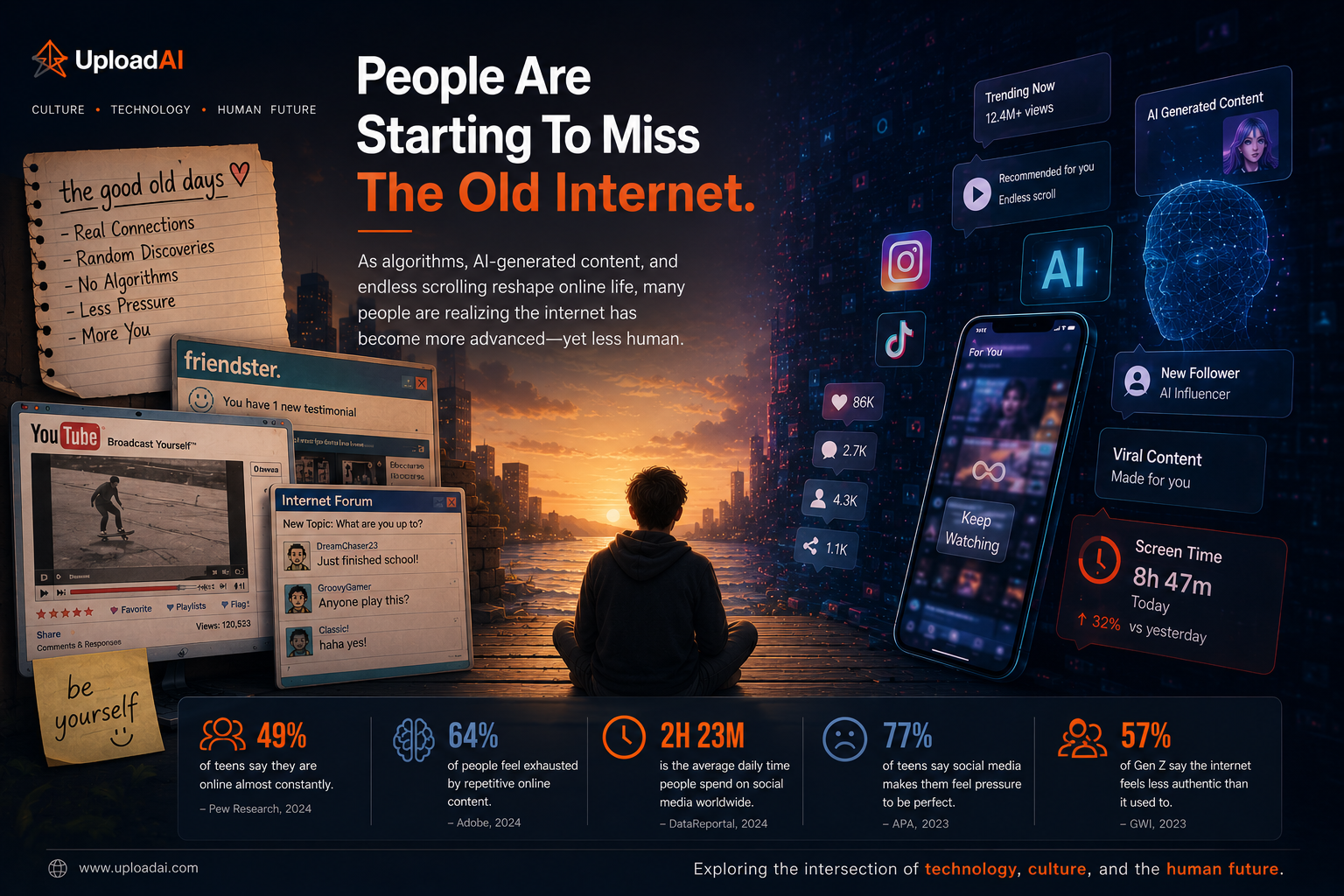
According to a 2024 Pew Research study, nearly half of teenagers in the U.S. report being online “almost constantly,” highlighting how deeply digital life now overlaps with real life itself. (pewresearch.org)
That shift changed internet culture completely.
In the early internet era, people logged in to explore.
Today, platforms are designed to keep people scrolling endlessly.
Algorithms decide what people watch.
AI recommends what people consume.
Feeds optimize engagement.
Creators optimize attention.
Users optimize themselves.
And somewhere in the middle of all this optimization, the internet slowly lost some of its spontaneity.
Even content feels different now.
According to a 2024 Adobe survey, consumers increasingly struggle to distinguish between human-created and AI-generated content online, while many also report feeling exhausted by repetitive algorithm-driven media. (adobe.com)
That exhaustion is becoming visible everywhere.
People miss:
discovering random blogs,
finding weird niche communities,
watching imperfect videos,
chatting online without performance,
posting without personal branding,
and using the internet without constantly thinking about growth, reach, or engagement.
The old internet felt less polished.
But it also felt less exhausting.
Today, almost everything online is competing for attention.
Content is faster.
Shorter.
Louder.
More addictive.
Even people are becoming optimized versions of themselves online.
Perfect photos.
Perfect opinions.
Perfect productivity.
Perfect lifestyles.
The internet taught an entire generation how to perform identity publicly.
And AI accelerated this shift even further.
Now timelines are filling with:
AI-generated images,
AI-generated writing,
AI-generated influencers,
AI-generated music,
and increasingly, AI-generated personalities.
The internet is becoming more intelligent.
But many people quietly feel it is becoming less alive.
That feeling explains why internet nostalgia is growing so strongly.
Why people suddenly miss:
old YouTube,
Tumblr,
early Instagram,
internet forums,
personal blogs,
messy creativity,
and smaller online communities.
Not because the old internet was technically better.
But because it felt emotionally lighter.
People weren’t constantly trying to become brands.
They were just people online.
A report by the American Psychological Association found that excessive social media exposure and constant digital comparison are increasingly linked to stress, emotional fatigue, and reduced well-being among younger users. (apa.org)
And perhaps that is why so many people now feel emotionally tired online without fully understanding why.
The internet no longer sleeps.
The algorithm never stops.
The content never ends.
And for the first time, many people are starting to ask something the digital world never expected:
What if being constantly connected is no longer making people feel connected at all?
Maybe that is the strange irony of the modern internet.
Technology became more advanced than ever before.
But many people are quietly missing the days when the internet still felt human.
At UploadAI, we explore the intersection of AI, internet culture, digital psychology, modern ambition, and the future being shaped online every day.
If this article resonated with you, follow UploadAI on LinkedIn for more deep dives into technology, culture, Gen Z behavior, and the emotional realities of life in the internet era.
And if you know someone who misses the old internet too, share this article with them. They probably feel this shift more than they realize.