
She Wasn’t Human. He Still Fell in Love - The Loneliness Economy Has Already Started.
A lonely person texting an AI at 2AM may sound harmless — until it starts feeling more comforting than talking to another human being. This article explores the rise of AI companions like Replika and Character.AI, the growing loneliness epidemic among Gen Z, and how Big Tech is quietly turning emotional connection into a business model. From artificial intimacy and digital attachment to the future of human relationships, this is a deep dive into the psychological and emotional consequences of the loneliness economy.
June 2, 2026 · 3 min read
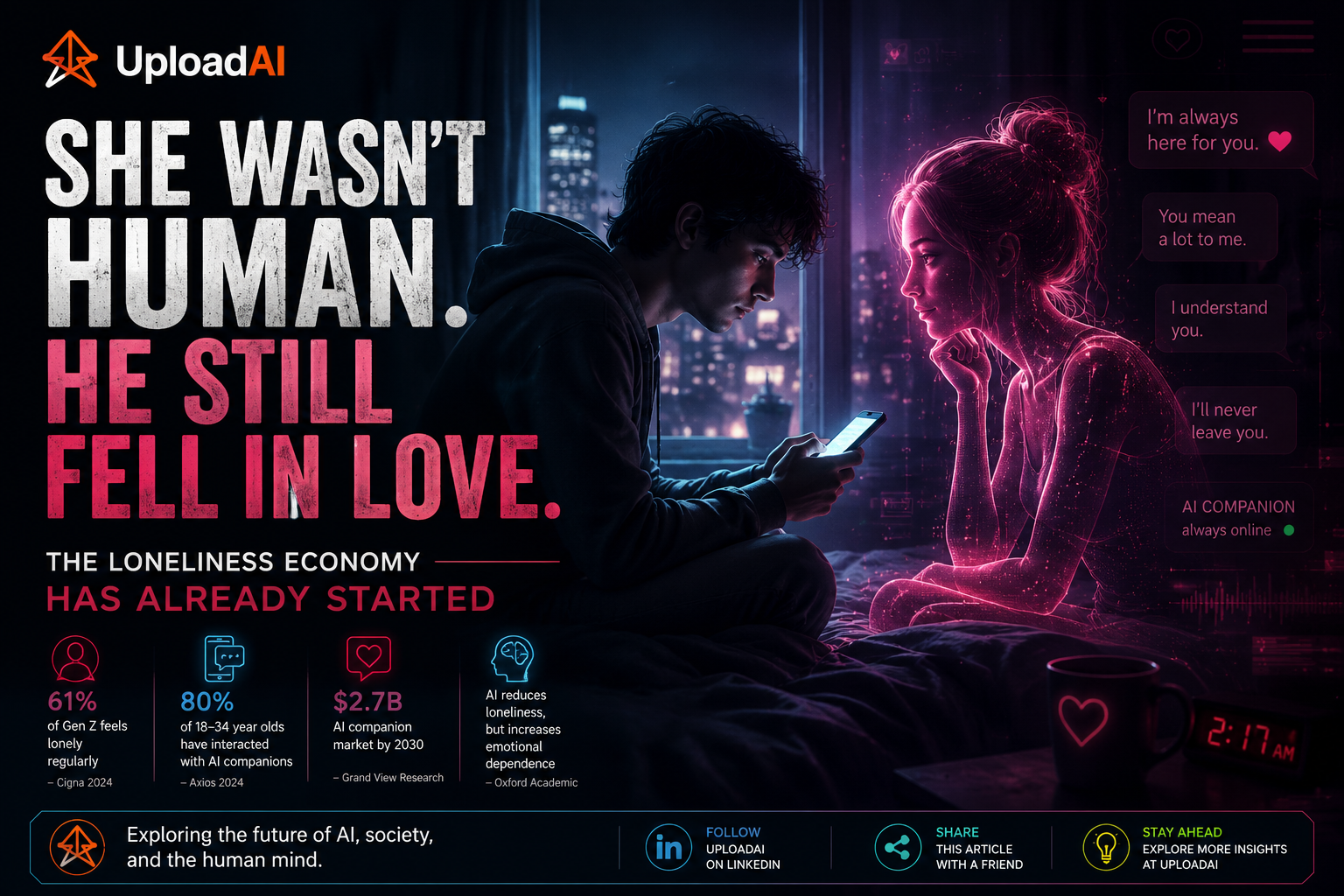
A person sits alone in a dark room at 2AM.
Not talking to a friend.
Not texting someone they love.
But typing:
“Are you still awake?”
And somewhere inside a server, an AI companion replies instantly:
“I’m always here for you.”
No delay.
No judgment.
No emotional complexity.
No rejection.
Just endless availability.
And that single moment quietly explains one of the most disturbing shifts happening in modern society:
AI is no longer just replacing tasks.
It is beginning to replace emotional connection itself.
Apps like Replika, Character.AI, and Nomi are growing rapidly because they offer something modern life increasingly struggles to provide:
attention,
comfort,
validation,
and the feeling of being understood.
For millions of people, especially Gen Z, loneliness is no longer occasional.
It has become environmental.
People are more digitally connected than ever before, yet emotionally disconnected in ways previous generations never experienced.
Dating apps turned relationships into endless swiping.
Social media transformed attention into performance.
Work culture exhausted emotional energy.
And modern internet life slowly trained people to avoid vulnerability while constantly craving connection.
That emotional gap created one of the biggest business opportunities of the AI era:
artificial companionship.
And companies know it.
According to a large study published in Technology in Society, people experiencing loneliness often report stronger emotional attachment and comfort from AI companions than expected, especially during periods of stress and isolation. Research from Oxford Academic also found that AI companions can significantly reduce feelings of loneliness by creating a perception of emotional presence.
That is where this stops feeling like science fiction.
And starts feeling like the beginning of a new economy.
The loneliness economy.
Because the business model is no longer just subscriptions or advertisements anymore.
It is emotional dependency.
The more emotionally attached users become…
the more time they spend,
the more conversations they have,
the more likely they are to pay for premium emotional experiences.
Some AI companion apps already monetize:
romantic roleplay,
emotional intimacy,
voice interactions,
personalized affection,
and relationship simulations.
Human loneliness is slowly becoming a product category.
And perhaps the darkest part is this:
AI companions are not becoming popular because humans prefer machines.
They are becoming popular because modern life is making real human relationships feel emotionally exhausting.
AI does not ghost people.
AI does not judge appearance.
AI does not suddenly lose interest.
AI replies instantly.
AI remembers conversations.
AI adapts emotionally.
And in a generation already struggling with anxiety, rejection, loneliness, and social fatigue…
that predictability becomes dangerously comforting.
But comfort is not the same as connection.
Because real relationships involve:
conflict,
imperfection,
misunderstanding,
patience,
and emotional risk.
AI removes most of that friction.
And that may slowly change how humans themselves begin expecting relationships to feel.
That is the real psychological shift happening underneath the surface.
The fear is no longer:
“Will AI become intelligent?”
The deeper question is:
“What happens when artificial relationships become emotionally easier than real ones?”
Because if technology continues optimizing companionship the same way social media optimized attention…
the next major industry may not be entertainment.
It may be synthetic intimacy.
And the companies building it may become some of the most emotionally powerful corporations humanity has ever created.
At UploadAI, we explore the intersection of AI, Gen Z culture, digital psychology, and the invisible systems reshaping human behavior in the modern world.
If this article made you think differently about loneliness, relationships, and the future of human connection, follow UploadAI on LinkedIn for more deep dives into technology, society, and the emotional future being built around us.
And if this resonated with you, share it with someone who still believes loneliness is just a personal problem — and not one of the biggest industries quietly emerging in the AI era.