The AI Boom Made Humans Feel Replaceable - Now Companies Are Rediscovering Human Skills.
The AI boom made millions of people question their relevance. As automation rapidly transformed industries, many feared human skills were becoming obsolete. But something unexpected is happening — companies are beginning to rediscover the importance of creativity, communication, emotional intelligence, leadership, and human judgment in the AI era. This article explores how AI didn’t eliminate human value, but instead exposed which human skills may become even more important in the future of work.
June 7, 2026 · 3 min read
For a while, the internet made it feel like humans were becoming outdated.
Every week brought another headline:
AI can code.
AI can design.
AI can write.
AI can automate jobs.
AI can replace teams.
People rushed to learn prompts, tools, automation, and workflows because the fear was no longer just falling behind.
It was becoming irrelevant.
And honestly, that fear changed something psychologically.
Students questioned degrees.
Employees questioned careers.
Creators questioned originality.
Even experienced professionals quietly wondered:
“What happens if AI becomes better than me?”
The AI boom didn’t just transform technology.
It transformed how humans saw their own value.
But now, something interesting is happening.
The same companies that aggressively pushed automation are slowly rediscovering the importance of human judgment, creativity, emotional intelligence, communication, and trust.
Not because AI failed.
But because people misunderstood what humans were actually valuable for.
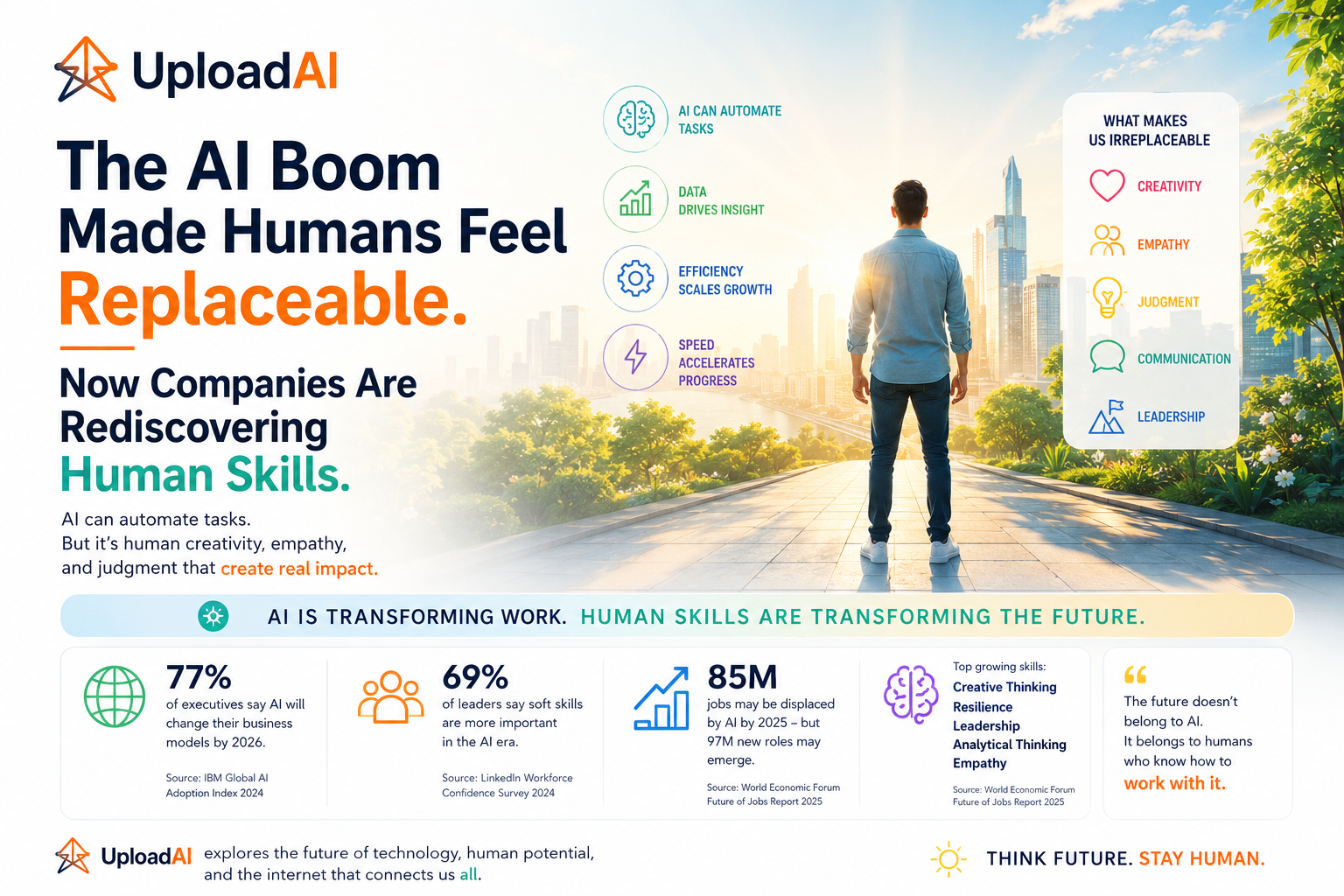
According to IBM’s 2024 Global AI Adoption Index, many companies that rapidly integrated AI still reported major gaps in human expertise, decision-making, and implementation quality — showing that automation alone could not replace experienced human understanding. (ibm.com)
That shift is becoming visible across industries.
Writers are using AI — but strong storytelling still matters.
Designers are using AI — but taste and creative direction still matter.
Developers are using AI — but problem-solving still matters.
Businesses are using automation — but human trust still matters.
AI accelerated execution.
But humans still shape meaning.
And perhaps that is what the internet forgot during the AI gold rush.
People assumed intelligence alone created value.
But in reality, some of the most important human skills were never purely technical.
They were emotional.
Creative.
Strategic.
Social.
Psychological.
A recent LinkedIn Workforce Confidence survey highlighted that adaptability, communication, leadership, and human-centered skills are becoming increasingly important alongside AI literacy in the modern workplace.
That matters because the future of work is no longer simply:
“humans vs AI.”
It is becoming:
humans who understand AI vs humans who don’t.
And the people thriving right now are not necessarily the ones trying to compete against AI.
They are the ones learning how to combine:
human creativity,
human intuition,
human communication,
and AI acceleration together.
That combination is powerful.
The internet often portrays AI like a replacement machine.
But in reality, AI is exposing something deeper:
Many repetitive skills are becoming automated.
But uniquely human abilities are becoming more valuable.
The ability to:
build trust,
tell stories,
lead teams,
understand emotions,
think creatively,
adapt quickly,
and make human decisions under uncertainty.
Those skills suddenly matter more than people expected.
Even major companies are beginning to recognize this.
According to the World Economic Forum’s Future of Jobs Report, analytical thinking, resilience, flexibility, leadership, and creative thinking are among the fastest-growing core skills for the AI era. (weforum.org)
That list says something important.
The future may belong not only to people who can use AI.
But to people who can remain deeply human while using it.
And maybe that is the real lesson of the AI boom.
Technology evolved faster than human psychology could process.
For a moment, the world became obsessed with replacement.
But now companies are slowly realizing:
automation without human understanding creates systems that are efficient — but emotionally empty.
Because humans do not connect with perfection.
They connect with:
stories,
meaning,
trust,
personality,
emotion,
and other humans.
AI changed work forever.
But it also reminded the world why human skills still matter.
At UploadAI, we explore the intersection of AI, internet culture, digital ambition, human psychology, and the future being shaped around us every day.
If this article resonated with you, follow UploadAI on LinkedIn for more deep dives into technology, culture, creativity, and the changing relationship between humans and AI.
And if you know someone anxious about their future in the AI era, share this article with them. The future may not belong to people AI replaces — but to people who learn how to evolve alongside it.