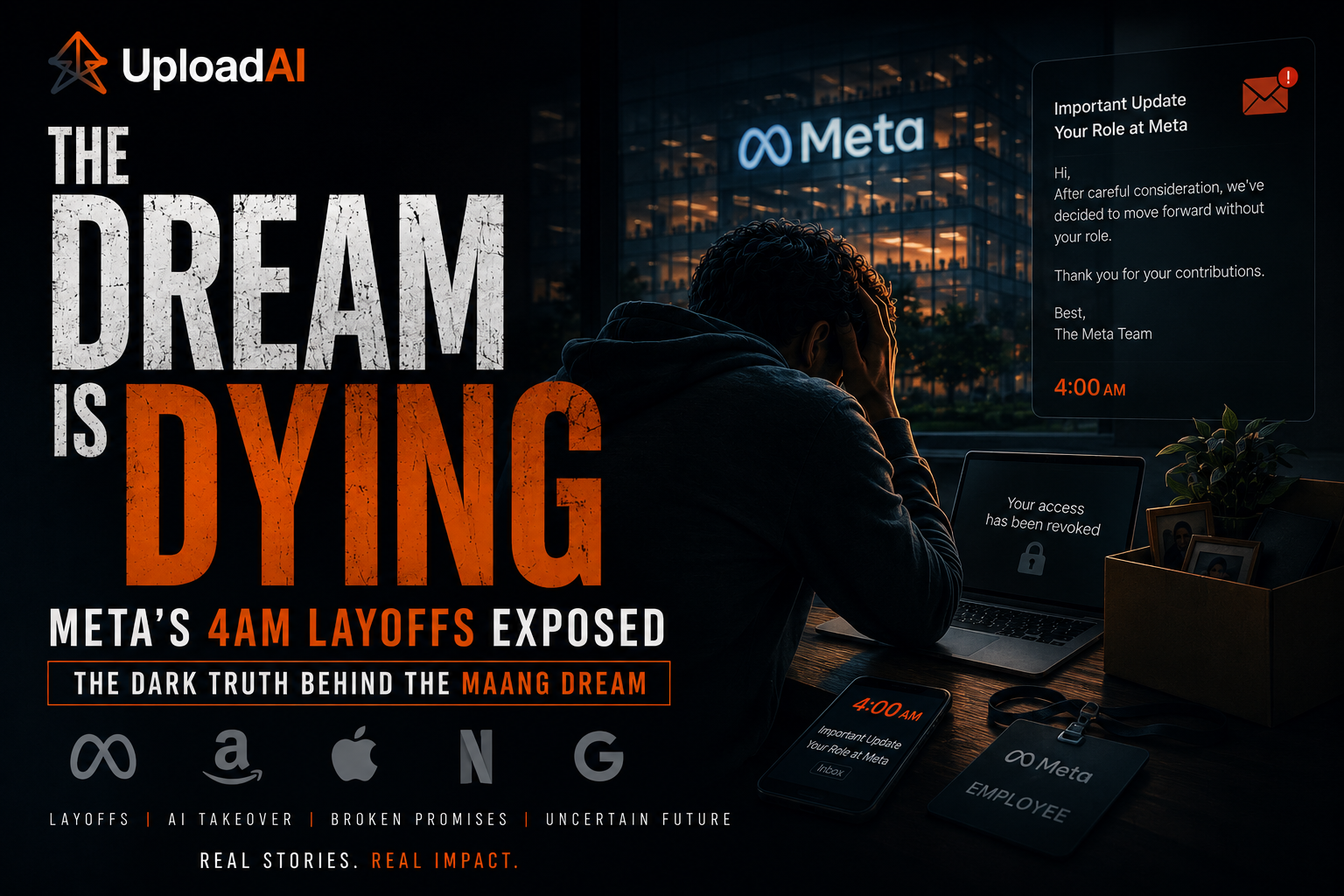
The Dream Is Dying - Meta’s 4AM Layoffs Exposed the Dark Truth Behind the MAANG Dream.
One silent email at 4AM was enough to destroy a dream millions of engineers grew up believing in. For years, companies like Meta, Google, Amazon, and Microsoft represented the ultimate definition of success — high salaries, prestige, stability, and the promise of a secure future. But behind the polished campuses and billion-dollar offices, something is beginning to crack. Why are profitable tech giants suddenly laying off thousands? Why does the “dream job” now come with fear, anxiety, and uncertainty? And is AI quietly changing the meaning of job security forever? This article explores the emotional collapse of the MAANG dream, the growing distrust toward Big Tech, and why an entire generation is starting to question the future they were promised.
May 25, 2026 · 2 min read
One day, the dream company stops feeling like a dream.
No dramatic announcement.
No emotional goodbye.
Just a silent message:
“Work from home tomorrow.”
And somewhere across the world, at 4AM, thousands of employees wake up to an email that quietly deletes the future they thought they had built.
Not because the company was failing.
Not because the industry collapsed.
But because Big Tech changed the rules.
For years, an entire generation was told that getting into Meta, Google, Amazon, or Microsoft meant security. Stability. Success. The perfect life. Crack the interviews, survive the grind, get the badge — and you had “made it.”
That dream built modern engineering culture.
It shaped careers, identities, even self-worth.
But now the same companies that once sold the safest future in tech are teaching Gen Z something terrifying:
You are replaceable.
And maybe you always were.
The layoffs are no longer shocking anymore.
That’s the disturbing part.
Every few months another headline appears:
Meta.
Amazon.
Microsoft.
Google.
Cisco.
Different company.
Same story.
Smaller teams.
Higher efficiency.
AI-first future.
And behind all those polished corporate phrases are people silently refreshing emails every morning before work, wondering if today is the day their access gets revoked.
Some laugh about it in group chats because fear has become a workplace culture.
Some pretend everything is fine while updating resumes at midnight.
Some are building the very AI systems that might eventually eliminate the need for them altogether.
That’s the psychological twist nobody prepared this generation for.
The people building the future are no longer sure if they belong inside it.
And maybe that’s why Gen Z is slowly starting to distrust Silicon Valley.
Because the campuses still look beautiful.
The salaries still look unreal.
The LinkedIn posts still look motivational.
But behind the glass buildings and free coffee machines, something has changed.
The peace is gone.
The dream job now comes with anxiety attached to it.
And for the first time in years, young engineers are beginning to ask a question nobody imagined a decade ago:
If even Big Tech jobs are no longer safe…
then what exactly is the future we were promised?
The future is changing faster than most people are emotionally prepared for.
And somewhere between AI, layoffs, automation, and corporate ambition, an entire generation is trying to figure out what stability even means anymore.
At UploadAI, we don’t just cover technology.
We explore what technology is doing to people, careers, culture, identity, and the future itself.
If this article made you think, question, or feel something deeper — stay connected with UploadAI.
Follow us for more stories on AI, Gen Z, Big Tech, future careers, digital culture, and the psychological shifts shaping tomorrow.
And if this resonated with you, share it with someone else who’s trying to understand where the world is heading next.