
The Internet Taught Us How To Work - But Nobody Learned How To Rest
The modern internet taught an entire generation how to stay productive — but never how to truly rest. From hustle culture and nonstop self-improvement to AI-driven ambition and digital comparison, this article explores why so many people today feel guilty while relaxing, emotionally exhausted while succeeding, and constantly pressured to keep moving. A deep reflection on productivity culture, Gen Z burnout, and the psychological cost of always being online.
June 5, 2026 · 3 min read
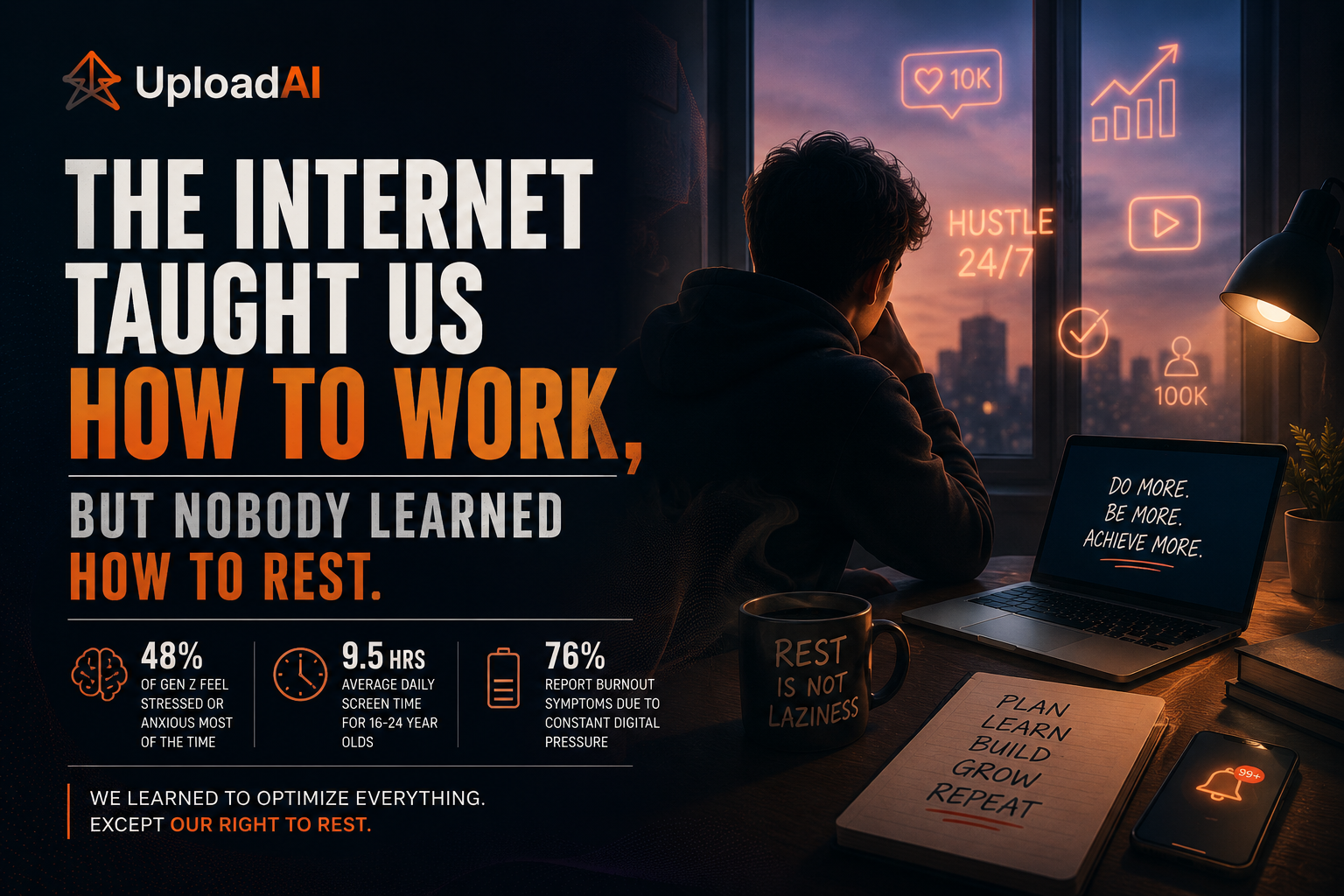
The internet taught people how to optimize almost everything.
Sleep schedules.
Morning routines.
Productivity hacks.
Side hustles.
Personal branding.
Networking.
AI tools.
Career growth.
An entire generation learned how to stay busy before it truly learned how to stay still.
And somewhere along the way, rest quietly started feeling unproductive.
A person sits down to relax for ten minutes.
But instead of feeling calm, their brain whispers:
“You could be learning something.”
“You should reply to that message.”
“You’re falling behind.”
“You’re wasting time.”
That feeling has become so normal that most people no longer question it.
But it reveals something deeper about modern internet culture.
The digital world didn’t just change how people work.
It changed how people emotionally measure their self-worth.
Today, being busy often feels more valuable than being healthy.
And the internet accelerated that mindset at a massive scale.
LinkedIn celebrates nonstop achievement.
Instagram glorifies hustle lifestyles.
YouTube promotes endless self-improvement.
TikTok compresses ambition into 30-second motivational clips.
Every platform quietly teaches the same message:
Keep moving.
Keep building.
Keep improving.
Keep optimizing.
Because someone else already is.
And Gen Z grew up inside this environment.
According to Deloitte’s Global Gen Z and Millennial Survey, nearly half of Gen Z respondents report feeling stressed or anxious most of the time, with career pressure, financial uncertainty, and constant digital comparison being major contributors. (deloitte.com)
That pressure becomes even more intense in the internet era because ambition is now visible 24/7.
People no longer compare themselves only to classmates, colleagues, or neighbors.
Now they compare themselves to:
creators making money online,
entrepreneurs posting success stories,
influencers documenting perfect lifestyles,
AI experts learning faster,
founders building startups at 21,
freelancers earning globally from laptops.
The internet turned success into a nonstop live stream.
And while this created extraordinary opportunities, it also created a generation that often struggles to disconnect from productivity itself.
A report from the American Psychological Association found that younger generations increasingly associate personal value with productivity and achievement, contributing to rising burnout and emotional exhaustion. (apa.org)
That may explain why rest today feels strangely uncomfortable.
People open laptops during vacations.
Reply to work messages at midnight.
Watch productivity videos while eating.
Turn hobbies into side hustles.
Track self-improvement constantly.
Even relaxation is becoming optimized.
The modern internet created a culture where doing nothing feels almost illegal.
And AI is accelerating this pressure even further.
Because every day the internet reminds people:
learn faster,
adapt faster,
work smarter,
automate more,
build quicker,
stay ahead.
The fear is no longer just failure.
It is becoming irrelevant.
That is why so many people today feel mentally tired even when they are technically “resting.”
Their minds never fully leave the algorithm.
Notifications continue.
Feeds continue.
Comparison continues.
Opportunities continue.
The internet never truly pauses.
And increasingly, neither do people.
But perhaps the biggest irony of modern ambition is this:
The same internet that created endless opportunity also made many people forget that human beings were never designed to operate like machines.
Rest is not laziness.
Silence is not failure.
Slowing down is not falling behind.
And maybe one of the most important skills of the AI era will not simply be learning how to work faster.
It will be learning how to stay human while the world constantly pushes people to optimize themselves.
At UploadAI, we explore the intersection of AI, internet culture, modern ambition, digital psychology, and the changing emotional realities of life online.
If this article resonated with you, follow UploadAI on LinkedIn for more deep dives into technology, culture, Gen Z behavior, and the future being shaped around us every day.
And if you know someone who feels guilty while resting, share this article with them. They are probably not alone.