
Why Companies Are Firing Gen Z - The Death of Workplace Loyalty
A cinematic deep dive into the growing conflict between Gen Z employees and traditional corporate culture. This blog explores how AI, automation, social media, burnout, and changing workplace expectations are reshaping the future of work. From quiet quitting to collapsing loyalty, it uncovers why the modern workforce feels more disconnected than ever — and why the “hired and fired” era has already begun.
May 21, 2026 · 5 min read
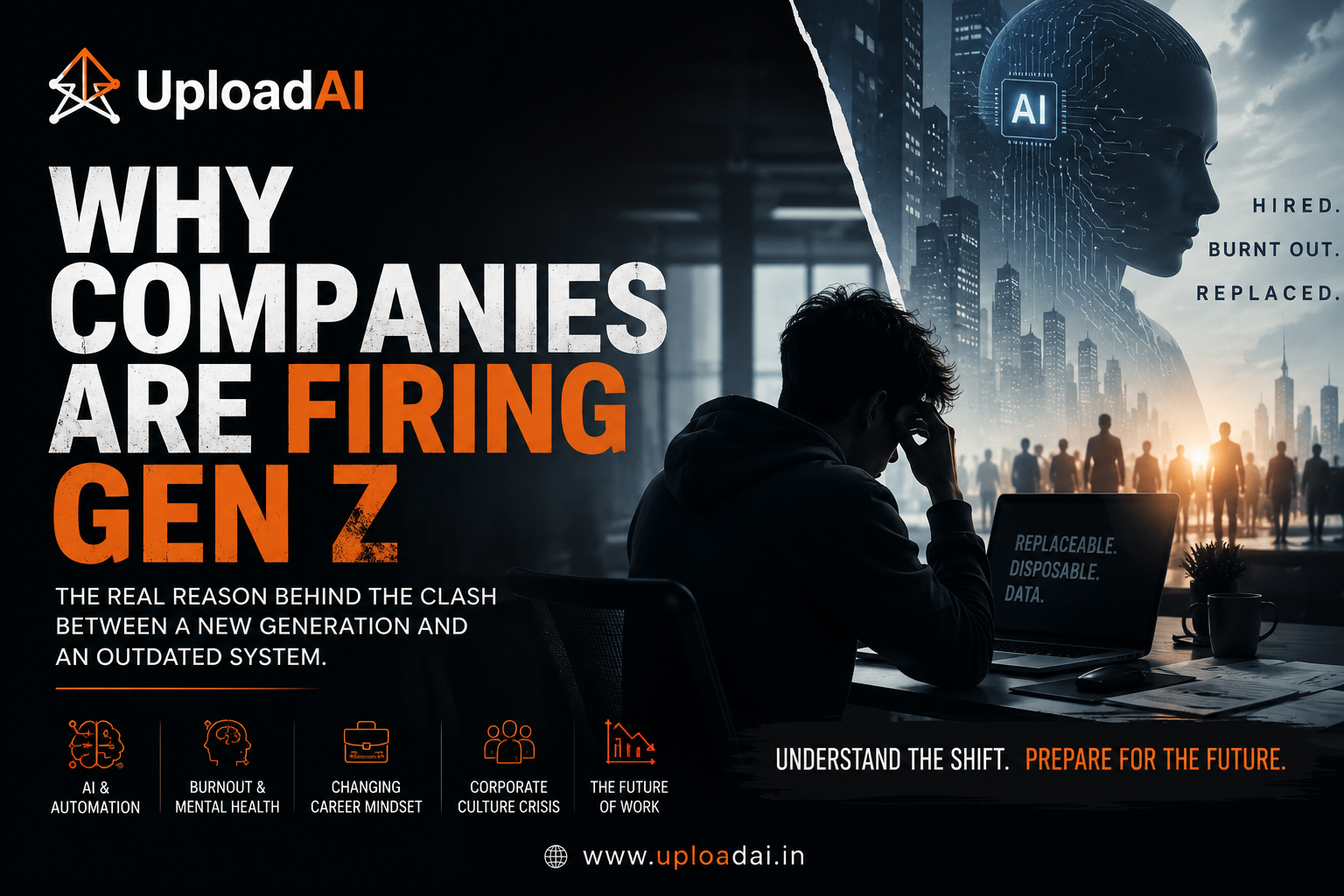
There’s a strange pattern spreading across companies around the world.
HR managers are frustrated.
Employees are disengaged.
And an entire generation is being blamed for it.
From America to Europe to India, corporations keep repeating the same complaints:
“Gen Z lacks discipline.”
“They quit too quickly.”
“They don’t respect authority.”
“They don’t stay loyal.”
Some companies have even started openly admitting:
They prefer not hiring Gen Z at all.
But here’s the real question:
Is an entire generation suddenly broken…
or is the modern corporate system quietly collapsing under its own outdated design?
Because history has seen this before.
Every new generation is called rebellious by the old one.
The same happened with Millennials.
The same happened in the 1960s.
But this time is different.
This isn’t just a generational clash anymore.
This time, artificial intelligence is rewriting industries.
Automation is replacing certainty.
Social media is reshaping ambition.
Mental health crises are exploding silently.
Remote work has changed expectations forever.
And the gig economy has completely altered the meaning of stability.
The workplace isn’t evolving gradually anymore.
It’s mutating.
And somewhere inside this transition, a new era has emerged:
The era of being hired…
only to feel replaceable from day one.
Because if you look closely, the data tells a disturbing story.
Across global HR reports, employers increasingly describe Gen Z employees as difficult to manage.
They complain about poor communication, low punctuality, weak professionalism, and constant job switching.
Workplace studies from organizations like Gallup and LinkedIn continue showing the same trend:
young employees are emotionally disconnected from work.
Engagement is falling.
Loyalty is shrinking.
Burnout is rising.
But calling this “laziness” is the easiest possible explanation.
Reality is far more uncomfortable.
Gen Z is the first generation in human history that grew up entirely inside the digital age.
They were raised with smartphones.
Shaped by social media validation.
Overloaded with information before emotional maturity.
And then hit by a global pandemic during their most formative years.
Psychologically, this generation was built in a completely different environment.
Studies repeatedly show higher anxiety levels, deeper burnout patterns, and stronger fears about financial insecurity among young people today.
Now imagine being 22 years old and growing up in a world where:
layoffs happen overnight,
AI can replace your role,
economic crashes feel permanent,
and stability itself feels temporary.
How exactly does traditional corporate loyalty survive in that environment?
Especially when corporations themselves stopped being loyal long ago.
And this is where the deeper conflict begins.
Most companies still operate with an industrial-age mindset.
Fixed hours.
Rigid hierarchy.
Attendance obsession.
Command culture.
“Boss is always right.”
But Gen Z entered the workforce with an entirely different operating system.
For them, output matters more than office hours.
Flexibility matters more than cubicles.
Purpose matters more than designation.
And most importantly:
Dignity matters more than blind obedience.
That collision is creating one of the biggest workplace identity crises of modern times.
Older systems demand sacrifice first and reward later.
Younger employees are asking:
“What if the reward never comes?”
And honestly…
that question is not irrational anymore.
Because social media changed something fundamental:
the psychology of work itself.
A job was once survival.
Now it’s comparison.
Open Instagram for five minutes and you’ll see luxury lifestyles, startup success stories, creators making millions, digital nomads working from beaches, influencers selling freedom as a lifestyle.
Now imagine a young employee sitting inside a fluorescent office building, staring at spreadsheets for ten hours a day…
while someone on YouTube earns more in a week talking to a camera.
The old psychological authority of traditional careers is collapsing.
Respect is no longer automatic.
Companies now have to earn it.
And then came a phrase that perfectly captured this shift:
Quiet quitting.
Doing your job…
but refusing emotional exploitation.
No unpaid overtime.
No fake loyalty.
No glorified burnout culture.
Corporate media called it laziness.
Young workers called it survival.
And the uncomfortable truth is:
both sides are partially right.
Because corporations spent years normalizing sudden layoffs, contract-based insecurity, and treating employees as replaceable assets.
Naturally, a generation raised inside instability will eventually ask:
“If companies aren’t loyal to us…
why should we be loyal to them?”
But then the situation became even more dangerous.
AI entered the picture.
And suddenly the future itself started feeling uncertain.
Reports from organizations like the World Economic Forum repeatedly warn that automation could eliminate millions of repetitive white-collar jobs.
Now imagine the mindset of a young employee entering the workforce today.
They already know:
their job may not exist in five years.
So the question becomes brutally simple:
Why dedicate your entire identity to a system that can replace you overnight?
This is where motivation begins collapsing.
Because companies still demand loyalty…
without guaranteeing stability.
And nowhere is this crisis becoming more intense than India.
India is one of the youngest major economies in the world.
Every year, millions of graduates enter the market:
engineers,
MBAs,
developers,
analysts,
designers.
But quality opportunities remain limited.
Add AI disruption,
low salaries,
gig work instability,
mass competition,
family pressure,
and nonstop social comparison…
and you create a generation living under permanent psychological pressure.
The result?
Anxiety.
Burnout.
Confusion.
Rapid job switching.
High expectations with low emotional security.
But the media still frames this as a “Gen Z problem.”
That’s the easiest narrative.
The harder truth is this:
this is a system crisis.
Industrial-age companies are trying to manage digital-age humans with outdated structures.
And the gap keeps growing wider.
Because the future of work may not look anything like the past.
Hybrid work could become the default.
The 9-to-5 model may slowly weaken.
AI may absorb repetitive labor entirely.
Creator economies may rival corporate careers.
And employees may become increasingly independent from institutions.
But the biggest shift of all might be this:
A job may stop becoming the center of human identity.
And perhaps that change is long overdue.
So maybe the real question isn’t:
“Why are companies firing Gen Z?”
Maybe the real question is:
Can corporations survive without evolving?
Because Gen Z is no longer asking only for salaries.
They are asking for:
respect,
flexibility,
purpose,
mental peace,
recognition,
and a life beyond survival.
And if companies fail to understand that…
the future workplace won’t become more stable.
It will become more disconnected,
more temporary,
more emotionally detached,
and far more fragile than ever before.
The era of “hired and fired” is no longer coming.
It’s already here.
Gen Z didn’t break the system.
They exposed what was already broken.
If this article resonated with you, support the blog with a like and share your thoughts below. And if it made you reflect differently on life, share it with someone who needs to hear it too.
— UploadAI