Why Gen Z Booed Former Google CEO Eric Schmidt- The Growing Revolt Against Silicon Valley’s AI Vision
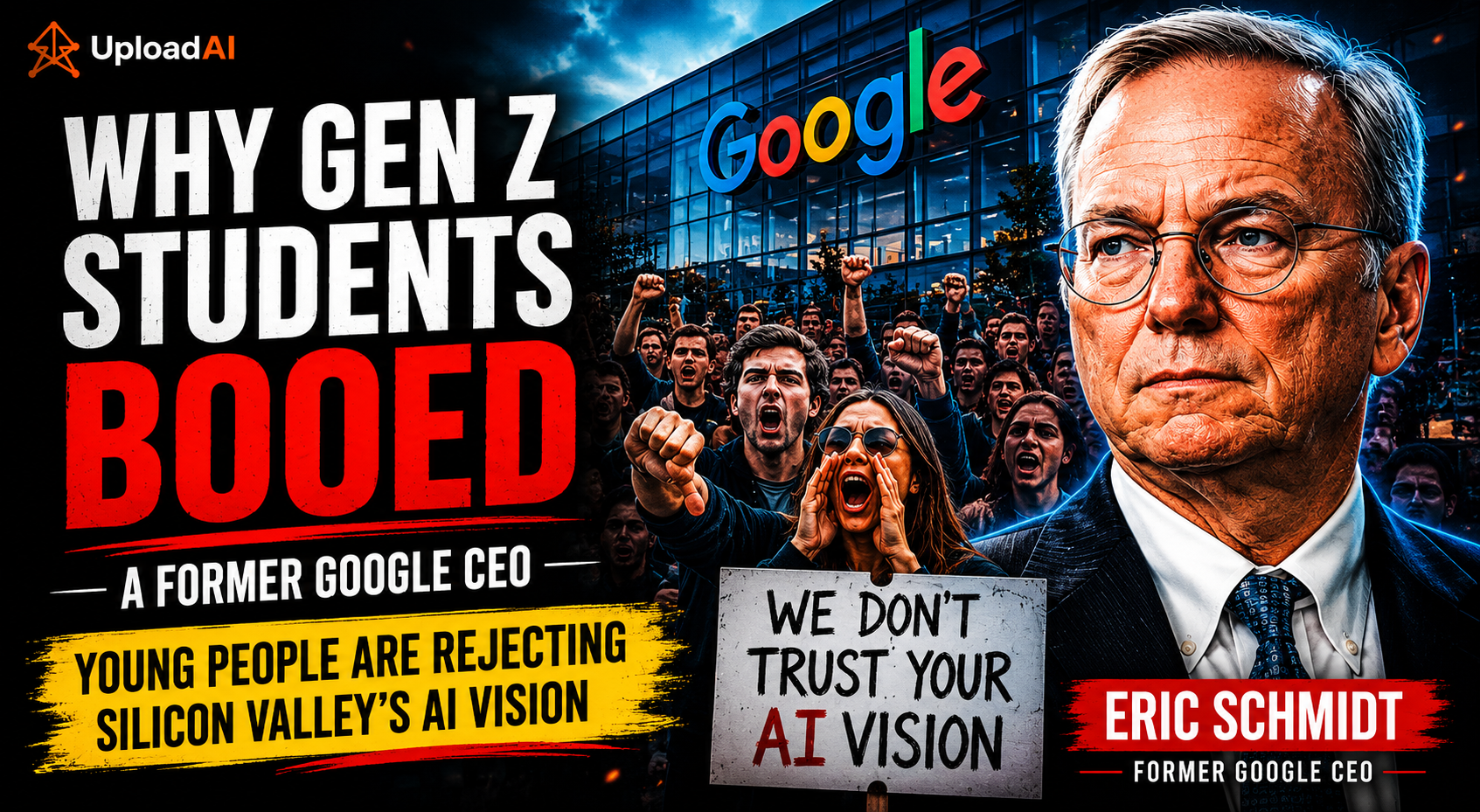
When former Google CEO Eric Schmidt mentioned AI during a graduation speech, Gen Z students started booing him live on stage. But this wasn’t just about one speech or one tech leader. It revealed something much deeper: a growing fear that AI, Silicon Valley, and the people building the future no longer represent the interests of ordinary young people. From job insecurity and AI anxiety to distrust toward tech billionaires, this article explores why an entire generation is beginning to question the future being created for them.
May 24, 2026 · 5 min read
For decades, Silicon Valley sold humanity a beautiful promise.
Technology would connect people.
Information would become free.
Innovation would create opportunity.
And the future would belong to everyone.
But something strange is beginning to happen now.
The same generation that grew up inside the digital revolution…
is starting to distrust the people who built it.
And nowhere was that more visible than at a graduation ceremony in Arizona.
Former Google CEO Eric Schmidt walked onto the stage expecting applause.
Instead, he was met with boos.
Not because he insulted the students.
Not because he failed to congratulate them.
But because he mentioned artificial intelligence.
And suddenly, one of the architects of the modern internet found himself standing in front of a generation that no longer sees technological progress the same way Silicon Valley does.
That moment mattered far more than people realize.
Because those boos were not directed only at Eric Schmidt.
They were directed at an entire era.
An era where tech leaders promised empowerment…
while quietly building systems that made millions feel disposable.
Schmidt began his speech by reflecting on the rise of computers and the internet.
How technology connected humanity.
Democratized knowledge.
Lifted people out of poverty.
And to be fair…
he wasn’t entirely wrong.
The internet changed civilization.
But then he admitted something unusually honest.
The same platforms that gave everyone a voice also destroyed public discourse.
They rewarded outrage.
Amplified division.
And slowly changed the way human beings speak to each other.
That sentence alone revealed something important:
Even the people who built the system now understand its damage.
But the atmosphere changed completely when Schmidt compared AI to the technological revolution created by computers.
The crowd immediately booed him.
And the reaction was deeply symbolic.
Because young people are no longer hearing the word “AI” as innovation.
They are hearing:
replacement.
Replacement of jobs.
Replacement of stability.
Replacement of identity.
Replacement of meaning itself.
For older tech billionaires, AI still feels like progress.
For many young people, it feels like economic extinction disguised as innovation.
That difference in perception is becoming one of the most important psychological divides of modern society.
And honestly…
the distrust did not appear out of nowhere.
Young people today inherited a world shaped by the same technology industry now asking them to trust AI.
An industry that:
destroyed attention spans,
engineered addiction,
normalized surveillance,
automated human interaction,
concentrated wealth,
and built billion-dollar platforms that profit from outrage more than truth.
Now those same companies are saying:
“Trust us again.
This time it will be different.”
But emotionally, an entire generation is struggling to believe that anymore.
Because trust collapses when people begin feeling sacrificed for progress instead of protected by it.
That’s why the boos became so powerful.
They revealed a hidden emotional reality:
Young people no longer fear only AI.
They fear the people controlling it.
And perhaps that fear is rational.
Because for years, technology companies presented disruption as something exciting.
“Move fast and break things.”
But nobody asked what exactly was being broken.
Careers?
Communities?
Attention spans?
Human relationships?
Economic stability?
Democracy itself?
At first, disruption sounded revolutionary.
Now it increasingly feels exhausting.
Especially to a generation already drowning in:
student debt,
housing crises,
layoffs,
burnout,
climate anxiety,
economic instability,
and nonstop digital overstimulation.
Then AI arrived…
and suddenly the future itself started feeling negotiable.
Schmidt tried addressing this fear directly during his speech.
He acknowledged that many students believe:
the jobs are disappearing,
politics is fractured,
the climate is collapsing,
and they are inheriting problems they didn’t create.
And perhaps for the first time in a long time…
a tech leader heard the emotional temperature of the room correctly.
But then came the deeper issue.
He still believed the future remained in their hands.
Many young people no longer believe that.
That’s the real crisis.
Because once a generation starts feeling powerless inside the future being designed for them…
society enters dangerous territory.
And maybe that explains why commencement speeches about AI now receive boos instead of inspiration.
Graduation ceremonies once symbolized hope.
Today, many students leave universities wondering whether the careers they studied for will even exist by the end of the decade.
That psychological shift changes everything.
The fear is no longer:
“Will AI become intelligent?”
The fear is:
“Will humans remain economically necessary?”
And the uncomfortable truth is that many AI leaders continue speaking about automation with the emotional distance of people who will never personally suffer its consequences.
Because the people building AI are usually not the people at risk of being replaced by it.
That contradiction is impossible to ignore.
Silicon Valley still speaks the language of innovation.
But millions of young people have started hearing something else underneath it:
detachment.
The detachment of billionaires discussing “workforce transformation” while ordinary people fear unemployment.
The detachment of executives promising efficiency while entire industries prepare for disruption.
The detachment of people powerful enough to survive any technological revolution asking everyone else to simply adapt.
And history shows something dangerous:
When ordinary people stop trusting elites during periods of rapid technological change…
social instability follows.
That’s why this moment matters.
Because the boos at Arizona were not anti-technology.
They were anti-powerlessness.
A generation demanding answers from the people redesigning reality itself.
And perhaps the most important part of all this is that the students were not rejecting the future.
They were rejecting the idea that the future should belong only to the people building it.
Because technology without trust eventually creates fear.
And innovation without accountability eventually creates resistance.
The AI revolution is not only changing machines anymore.
It is changing the emotional relationship between humanity and the people shaping civilization itself.
That relationship is becoming increasingly fragile.
And if the tech industry continues treating human anxiety like a temporary obstacle instead of a legitimate warning…
the resistance against AI may become far larger than Silicon Valley expects.
Because the next great technological conflict may not be humans versus machines.
It may be ordinary people versus the elites deciding what humanity becomes next.
Maybe the most dangerous part of the AI revolution is not the machines becoming powerful…
but humanity slowly losing trust in the people building them.
The future is being written right now.
And whether it becomes liberation or replacement depends on who controls it — and who questions it.
If this article made you think differently about AI, power, and the future we are all being pushed toward, support UploadAI with a like and share your thoughts in the comments below.
And if this resonated with you, share it with your friends — because conversations like these will shape the world far more than algorithms ever will.
Follow UploadAI on Instagram and LinkedIn for more deep dives into technology, society, AI, and the future of humanity.
— UploadAI